The 2019 Tradeswomen Building Bridges Delegation to India arrives in Kerala on Nov. 2: Meet the Delegates

The 2019 Delegation is made of 12 women from the US and Canada and a researcher. They will be spending 5 days with the women of the Archana Women’s Centre and, the following weekend, with leaders and workers of KKNCT, the Kerala affiliate of the Builders and Wood Workers International (BWI) labor federation.

Delegation members will be posting here and keeping everyone informed on their facebook page, Tradeswomen Building Bridges. Follow and share the stories from these tradeswomen leaders.

MEET THE DELEGATES

Noreen Buckley
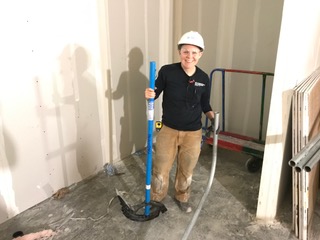
Noreen


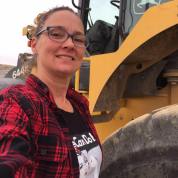
I am a 3rd year electrical apprentice in San Francisco – Local 6, co-chair of our women committee and was lucky to be part of the 1st delegation to India in 2017. I am excited to return this year and continue the good work of raising the visibility of Global Tradeswomen! 


Amber McCoy
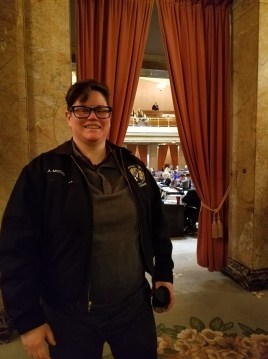
AmberAmber McCoy is a journey level Union Carpenter from Portland Oregon. They indentured into the Carpenters apprenticeship in 2006 and graduated with Honors in 2010. McCoy is an Instructor with Pacific NW Carpenters Institute and hold many positions, elected and appointed, in the Union and in Local politics. 


Amanda Kay Johnson
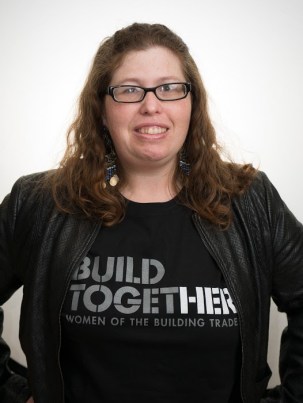
AmandaHas worked in construction for the last 6.5 years and is currently employed as a second year apprentice with the NYC District Council of Carpenters in Local Union 157.  During her time as an apprentice, she has both completed her Masters Degree in Civil Engineering and Construction Management at NJ Institute of Technology and been a part of multiple committees within her union and trades leadership conferences.  In addition to her life as a carpenter, Amanda Kay enjoys traveling all over the world, getting lost in nature, writing poetry and music, spending time with her family, and propelling the international tradeswoman movement forward. 


Jenna Lipinski

Jenna


Greetings! My name is Jenna Lipinski, I am born and raised in Regina, SK Canada. I am a Bricklayer and Executive Board Member of BAC Local 1 Saskatchewan and Chair of the Build Together Saskatchewan Chapter. 


Kathryn (Katy) Rhodes

katy

My name is Kathryn (Katy) Rhodes and I’m a fourth year apprentice electrician with IBEW 213. I’m a member of our women’s committee as well as Build TogetHER and am heavily involved in efforts to recruit and retain women in trades. With these organizations I have headed a volunteer work weekend to support WISH (an outreach centre for women of the downtown east side of Vancouver BC) as well as several trade shows and girl guide/brownie (similar to Girl Scouts) outreach. I’m so excited to be a part of this badass group of women working together to lift each other up. 


Antoniette “Ant” Yap
Ant


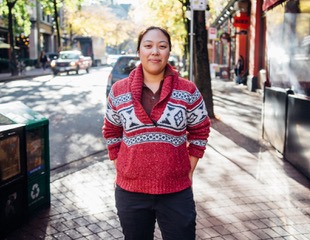
Always on the run but never from the law…Antoniette jumps towards any opportunity to explore, learn, contribute, and inspire especially in situations so far from her comfort zone. When driving in an air cooled beetle from Vancouver to Florida, Antoniette traded in her desk job for something a little more fun… being a union Millwright.


Julie Enman

JUlie


Julie is a Red Seal Carpenter/farmer, who meanders between teaching, work in the humanitarian aid sector, and of course carpentry.  When not doing those things, Julie spends time playing fiddle or with fire.  Julie is also good at drinking beer while listening to brutal metal.

Veronica Godinez

Veronica


JourneyWoman Cement Mason with 20+ yrs in the Trades as a Concrete Finisher, Instructor, later Safety Coordinator then Manager and now Apprenticeship Director. Member of Local 400 and the Steel Edge Women of the OPCMIA. Excited to join this amazing delegation with the common goal of empowering the advancement of all women.


Denise Dauvin
denise


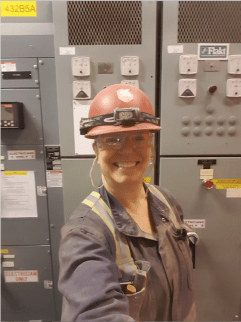
My name is Denise Dauvin and I work as an Industrial Electrician at a Pulpmill in Prince George, British Columbia. I have worked in Industry for almost 30 years supporting my two daughters and myself. I am hoping to set an example and make changes in industry for future generations of young girls.
I am excited for this opportunity in India, and meeting the amazing women in this group.


Cassandra Klewicki
Cassandra


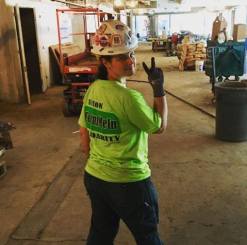
Cassandra is a carpentry apprentice out of Local 290 from Long Island, New York. This is her second time travelling to India. She is an organizer for Suffolk County chapter of the  Democratic Socialists of America and a member of the Suffolk County Planned Parenthood Emerging Leaders Council.


Jan Jenson
Jan


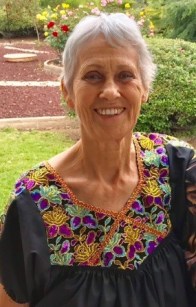
Retired ironworker – 25+ years!  1976-2003. Happily transplanted to Apache Junction, AZ

Photojournalist since 1958.  Dual career with ironworking – still taking pics & writing stories!

Health coach since 1968.


Chantal Krcmar

Chantal


Chantal Krcmar is a PhD candidate in the Department of Global Governance, Human Security and Conflict Resolution at the University of Massachusetts – Boston. The focus of her dissertation is the Human Security of Indian women who work in the construction industry. Though her last port of call was Somerville, MA, Chantal, her husband Rahul, and daughter Anamika are currently living in Mumbai.


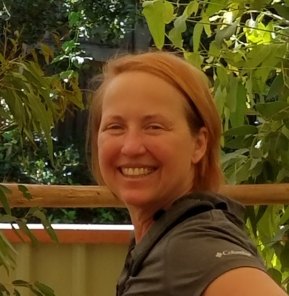
Susan Fischer
Susan

Susan Fischer is a professional florist. Over the course of her nearly 30 year career she has worked in every aspect of the industry. The need to document her creations and network with suppliers has led her to become an amateur photographer and a world traveler.
 

Posted in Uncategorized | 4 Comments

Still Building Bridges: US Tradeswomen are returning to India

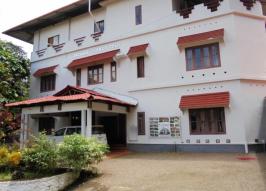
In November 2019, a delegation of tradeswomen from around the United States will be joining women construction workers in Kerala India for Building Bridges: The 2019 Tradeswomen’s Training Exchange. The trip will be led by Carpenter Amanda Johnson of New York City, Electrician Noreen Buckley of San Francisco and Carpenter Amber McCoy of Portland, OR. A dozen other tradeswomen, including bricklayers, plumbers, millwrights and laborers have applied to join the delegation. Details are being finalized. The Training Exchange will be hosted by the Archana Women’s Centre in Kerala where women have received training in masonry and carpentry for several decades. The beautiful building that houses the Centre was built by women.2 (1000x750)_10

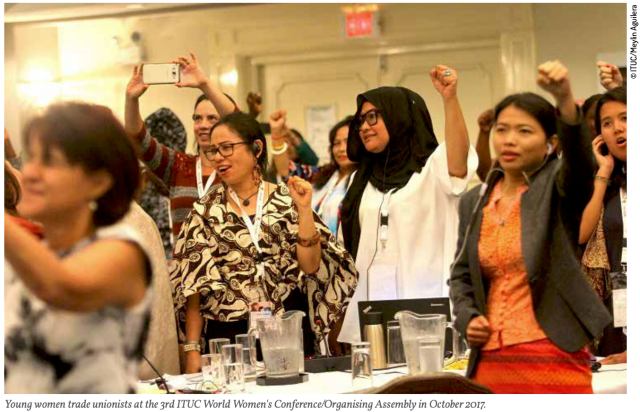
Following the Training Exchange between the women of Archana and the US tradeswomen, the delegation will go on to meet with union affiliates of the Builders and Woodworkers International (BWI). “The BWI is the Global Union Federation grouping free and democratic unions with members in the Building, Building Materials, Wood, Forestry and Allied sectors.”  BWI representatives participated in the 2017 Building Bridges Delegation’s Conference at VV Giri Labour Institute in Noida, India and attended the 2018 Women Build Nations Conference in Seattle. Along with the International Trade Union Confederation (ITUC), BWI has recently published a report, Count Us In! Women Leading Change,” about the need for greater power for and leadership by women in the global trade union movement. BWI is also in discussions with Building Bridges and many other tradeswomen’s groups on a plan for an international conference for women working in the construction trades in 2020.

Stay tuned for updates on the Building Bridges Tradeswomen’s Training Exchange.

Here are a couple of excerpts from Count Us In!

  • “Trade unions stand at the vanguard of resisting corporate greed, rebuilding peace and democracy and establishing social, economic and gender justice. If we are to succeed, we need to transform our own organisations. Whilst progress is being made, there are still far too few women in positions of power and influence in the decision-making bodies of trade unions.” page 2.
  • “The importance of creating networks for women in trade unions cannot be overstated. Whether at a local, sectoral, national or international level, whether online or offline, they not only allow women to strategise and support one another, but they also provide vital access to leadership roles and elected positions. There are some within the union movement who still ask: ‘Why do you need a separate gender department?’ or ‘What’s the point of a women’s committee?’ but these structures are crucial safe spaces for the incubation of gender equality policies and the next generation of female leaders. One of the major challenges, however, lies in ensuring that unions integrate gender equality throughout their organisational agendas and structures – and this way successfully transforming the movement.” page 14.

Screenshot 2018-11-30 13.37.33


Posted in Uncategorized | 1 Comment

How Marie Met Melody: Sisters in the Trades Making Global Connections

Kelly McClellen, IUOE 101 and member of HWIT- Heartland Women in the Trades, was a Delegate on the 2017 Building Bridges Tradeswomen’s trip to India. Kelly is a leader in making global connections with tradeswomen. At Women Build Nations 2017 in Chicago, the Building Bridges Delegation invited two tradeswomen advo-

17155372_10212553272853707_159032836003063740_n

Kelly McClellen

cates who we had met in India to attend the conference and share their knowledge of women working in construction in India. See our post on their visit from last year.

Kelly hosted our two guests for a couple of days after the conference. She invited a few other US tradeswomen to join the group for dinner at an Indian restaurant one night and that is when she met her now very good friend, Marie Fletcher Olson, journeyman Ironworker from Local 118 in Sacramento. Marie told Kelly a fascinating story of tradeswomen making connections from Sacramento to the Philippines. Kelly asked Marie to tell us that story here.

Marie’s story:

Some years ago, I was injured at work and was placed in the office for over a month. I was scanning friends’ pages on Facebook when I came across Melody Lavarez, a welder in the Philippines. I reached out and asked her how she became a welder. We began a conversation that started over a few days and continues today. Melody’s dream is to help women. We worked together to build a website to find women welders in the Philippines. I suggested that, because her country in some parts is against unions, we get enough women in the group before we go public. We got over a hundred women involved through the website. This is when I asked Pat Williams, retired Operating Engineer from Los Angeles,  and Melina Harris, Carpenter from Sisters in the Building Trades, to get involved and help me unite us with the Filipino women. Pat spent many many hours mentoring Melody and Melina was able to connect through the Carpenters and the Builders and Woodworkers International (BWI). With support from BWI, Melody and the women welders were able to form their own organization, “Pinay Tradeswomen.” They now have over 300 members and are affiliated with the National Union of Building and Construction Workers (NUBCW).


This past year, Americans sisters in the building trades went to the Philippines to meet with Melody and her sister welders.

Screen Shot 2018-08-24 at 3.28.22 PM

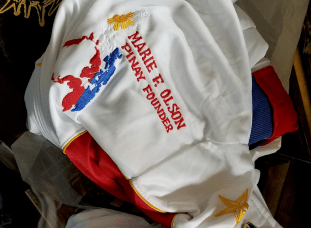
Marie has been recognized as a founder of Pinay Tradeswomen

I could not attend as I was in OSHA safety programs preparing to teach all-women ironworking classes here in the states. Melody is now working on the first ever all-women construction team on the Philippines including female engineers. They hope to start a training school built by women and run solely by women. They are still in need of a working truck and welding equipment to make this happen. Melina has sent a small shipment of tools and donations from the American sisters in the trades to them.


I am grateful for the advice from both Pat Williams and Melina Harris and for their help in fighting to make the dream possible—the dream of Filipino women from Manila and all the other provinces of the Philippines to move together to make their country more employable for women. Some women still go to work and hide as men to work in the construction trade, but it is so much better then when we started making connections.

USAtoPhilippines

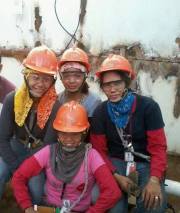
Women welders in the Philippines

Melody has done many TV shows explaining the sisters in the trades and how, by sticking together, women can change their working conditions. These women are more than wives who stay at home and raise babies and take care of sick people. They are women working to support their families. Melody dreams of volunteering to rebuild schools, housing, hospitals and churches. My dream is to help her succeed. We have yet to meet in person but we talk on the phone and message each other every week.

See Melody talking about women, leadership and the power of women here. Hopefully, Melody, Marie and Kelly will all meet in a couple of years at the International Tradeswomen’s Conference! Still in the talking stage but stay tuned here as information develops.

Posted in Uncategorized | 1 Comment

What’s happening with Building Bridges with the women construction workers of India… and across the world?

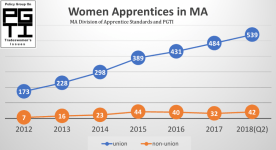
It has been a long time between posts. Over the past year, I have been more focused on the work in the US of “crushing the barriers of women’s access to good jobs in the union construction trades.” apps 2018We have more then tripled the number of women in union construction in Massachusetts and we are working with sisters across the country and Canada on our goal of 20% tradeswomen by 2020. Here’s a picture of our progress in Massachusetts. You can learn more about this at PGTI: The Policy Group on Tradeswomen’s Issues and Build A Life that Works.
But the international connections continue to be built.

Through social media, Melena Harris of Sisters in the Building Trades made contact with tradeswomen who were organizing in the Philippines. Women welders led the way for tradeswomen to organize themselves into the Pinay Tradeswomen. (See more on this story on page 10 of the Pride and a Paycheck Magazine from 2016.) Melena then connected the women in the Philippines with the Builders and Woodworkers International (BWI) and their Philipines affiliate, the National Union of Building and Construction Workers. BWI is a “Global Union Federation grouping free and democratic unions with members in the Building, Building Materials, Wood, Forestry and Allied sectors.” In other words, an international union for construction workers. BWI has a large presence in India. Representatives supported the Building Bridges Delegation to India in 2017 and attended the Building Bridges 2017: The International Tradeswomen’s Conference in India.

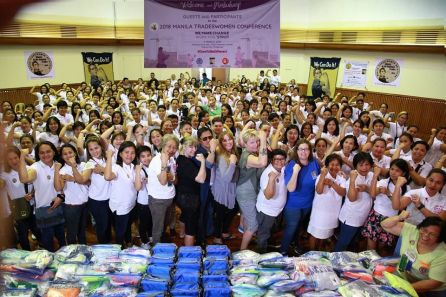
300414A circle was closed when BWI helped to pull together the Manila Tradeswomen Gathering in Quezon City this past March 4. A delegation of US tradeswomen also attended the Gathering after first going to Australia for a conference with tradeswomen there.


Next steps to building an international network of women working in the construction trades:

  • In BWI, we now have an international construction-based organization that will take leadership and devote resources to building the global network that many of us have worked on– with slim support– for many years. BWI is pro-union and pro-women with an active program to grow women’s leadership.
  • A meeting will be convened at Women Build Nations by BWI and Jin Sook Lee, BWI’s Global Campaign Director, in October in Seattle.
  • The Building Bridges Delegation is planning a Training Exchange with the Archana Women’s Centre in Kerala, India for the fall of 2019. This will be an opportunity for 8-10 US tradeswomen to spend a week at Archana learning about South Indian techniques in masonry and carpentry and providing the tradeswomen of Archana with introductory workshops on electricity and plumbing. We hope to also connect with BWI affiliates in Kerala to learn more about women working in construction in the region. More information will available soon.

Meanwhile the women construction workers of India continue to work under horrendously unsafe conditions. Last week, a building under construction in Ghaziabad collapsed killing one worker. Two women construction workers and their children were among the nine injured. A week earlier, nine were killed including a women and two children, when a building under construction in Noida collapsed.

31MA-CITYAITUC

“Utilise the fund:” Members of Tamil Nadu All India Trade Union Congress Construction Workers Association staging a demonstration in Madurai on Monday.   | Photo Credit: G_Moorthy

Yesterday, Monday, July 30, women construction workers staged demonstrations in Tamil Nadu. Members of Tamil Nadu All India Trade Union Congress Construction Workers’ Association have organized and protested for decades to protect the rights of women construction workers to their legally mandated benefits. All across India, only a fraction of the funds collected for the Construction Workers Welfare Boards is being distributed to the workers. These and other injustices are faced by women construction workers across the world. We will all be stronger when the international organization of tradeswomen is stronger.


Posted in Uncategorized | 3 Comments

The tradeswomen of the US delegation to India have been busy

We were able to bring two guests, Vrishali Pipati, Director of Mumbai Mobile Creches in Mumbai, and Thresiamma Mathew, Director of the Archana Women’s Centre in Kerala. Mumbai Mobile Creches is one several organizations across India that have been setting up childcare centers on construction sites for the children of migrant construction workers for almost 50 year. Archana has been training women in the masonry and carpenter trades for 30 years. The Centre itself was built entirely by women. An interview with Ms. Mathew about the work of Archana has just been published here.

archana

Before the conference, our guests spent time in St. Louis hosted by Carpenter Beth Barton and Missouri Women in the Trades (MOWIT). They visited the Bricklayers Local 1 apprentice training center and the carpenters training center, toured a Tarlton worksite at Washington University, attended a reception in their honor and saw a bit of St. Louis.

On Thursday, the tradeswomen of St. Louis and our India guests jumped in a van for the 6 hour drive to Chicago to spend the weekend with 1800 tradeswomen at Women Build Nations.

22426384_1512711272141738_6663262780419735552_n

The tradeswomen of Building Bridges organized two workshops at the conference, one on their 16 day trip to India last January and on future ideas for tradeswomen returning to India and the second on building global networks for women working in construction. The global workshop included women from India, Canada and Ireland and reports on tradeswomen organizing in Australia and the Phillipines. There was a lot of interest among many women in being part of future delegations of rank and file tradeswomen and in building networks with women working in construction around the world.

In the final session of the conference, the Building Bridges Delegation joined Thresiamma and Vrishali on stage as they addressed the participants in the plenary session.

22491457_10155894666332049_401093112527428348_n

Operating Engineers Kelly McClellen and Holly Brown played final hosts in Chicago after the conference with a visit to the Operating Engineers ginormous indoor training center and finally a bit of tourist time. Vrishali and Thresiamma flew home this past Wednesday.

22339605_10214584584997384_2851328229905153854_o

We hope to have our sisters and even more international representatives attend the next Women Build Nations when it happens in Seattle.


Posted in Uncategorized | 2 Comments

Edwina Patterson, Laborer from Minnesota, shares her thoughts on safety in India and the US

edwina and laborere

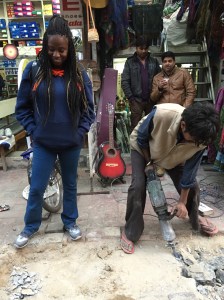
Edwina watches a laborer working in Delhi

So, as I walk down the street while in India I see a ton of construction but I don’t see much PPE (personal protective equipment). All I can think about is every time an inspector says where’s your hard hat, or where are your safety glasses, or my Foreman looks and notices I don’t have ear plugs in, and I get attitude and I roll my eyes but I still go get whatever PPE I need. I see these people working in sandals, some with no shoes on at all, no hardhat, no safety glasses, no work boots. Then I all I can think about is having an attitude because I have to put in earplugs. Wow…it is so intense when we are hit with a reality check and have to grow up. We need OSHA, we need regulation, we need employers that care. Guess my world’s not so bad after all.

Thank you, Edwina.


Posted in Uncategorized | 1 Comment

Janet Butler, India Delegate, gives her thoughts on the trip

Janet is the owner of Federal Concrete, Inc., a union concrete construction company that is signatory to the New England Carpenters, Laborers and Ironworkers. Janet represented union contractors on the trip (and in many other venues in Massachusetts!). Below are her thoughts on the Delegation and our time in India.


India was an amazing and dynamic place! The food, scenery, culture, and people were a sensory overload of sights, sounds and tastes. The hospitality we received from the Indian people was some of the kindest, generous and genuine I’ve ever encountered. Our hosts added rich narratives of Indian history and explained cultural norms and political positions. The time spent discussing gender equality and public policy issues amongst the delegation and with our hosts was an enlightening experience.

Governments tend to pass policies and regulations with honorable intentions, but often fall short in implementation. Some in government continue the practice of discrimination for expediency or other reasons which have a chilling effect on those who have the courage to speak in opposition. The similarities between our two countries in terms of persistent and ongoing discrimination is profound.

India is reminiscent of the pre-unionized era when workers were exploited with low wages and poor and unsafe conditions. Indian women experience the same type of wage inequality for equal work as many of their American female counterparts. Sexism is a barrier to entry, skills and opportunity.   Upward mobility for Indian women is limited. Leadership opportunities are not possible due to male dominance in the industry.  Passing laws without implementation or enforcement is a futile endeavor.  Cultural norms need to be changed.  Attitudes towards female aptitudes need to be reconstructed. The situation in India, and American, reinforces the need for both workforce goals and subcontracting requirements to provide increased opportunities for females.

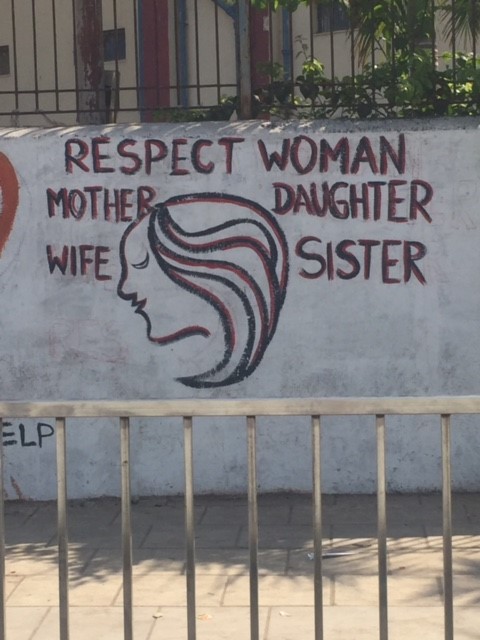
Women should celebrate each other and embrace our similarities and differences. We need to champion others to increase the numbers of women in leadership positions. A collective voice is stronger in unison.  Marching together at the Taj Mahal during the Women’s March in solidarity with ourselves and our sisters globally was a meaningful experience. Reading the newspapers the following day and hearing the number of women who participated was encouraging. Together we can make a change.

I departed Indian with a new-found appreciation for what it means to be privileged and have been changed by the experience.  With knowledge and power comes the ability to spark change and provide opportunity for others. I am honored to have had the opportunity to spend time in India to learn and listen with such a talented group of people.

respect-woman

Posted in Uncategorized | 1 Comment

Operating Engineer Kelly McClellen on demonetization of India’s currency

Late on November 8, 2016, the Indian government announced the “demonetisation” its currency. What did that mean? When the people of India woke up the next morning, the bills in their wallets, tucked in their sarrees, stashed under their mattresses, were worthless. They began a long process of standing in bank lines to have old bills replaced with new. The initial justification given was that demonitization would remove what the Indian government calls “black money” from the economy. In subsequent explanations, the government said that demonetization would drive “digitization” of the economy. In other words, it would force people to use plastic instead of currency. In addition the “Handmaid’s Tale” implications for loss of more control by workers and consumers, the policy ignored the needs of the vast numbers of poor Indians who work in the totally cash economy of the “informal sector.” In construction, it is estimated that 95% of workers are informal, paid in cash, not on the books and receiving few if any benefits. Successive Indian governments have failed to address this systemic expoitation of the construction workforce for decades. Demonitization crashed the construction sector overnight. We went to see women construction workers. We met unemployed women construction workers. Operating Engineer, Kelly McClennen, shares her thoughts on this issue below.

“November 9 was a taxing day for the US and India.  India took the cash economy out of their picture by removing the 5000 rupee notes and others. Those contractors that were exploiting workers by paying them pennies (in our world) were stashing their cash to pay for the work they have in India and only had until January 2017 to exchange it for smaller valued rupees. This was only allowed in small increments at a time so those Big Money Contractors that had a lot of them stashed didn’t have time to turn in all the money they had so eliminating their ability to continue their business. Some even burned big piles of their rupees to dispose of it!  In lieu of this construction sites were abandoned no matter how complete or incomplete they were. In my opinion, in the 3 large metro areas we visited, the number of sites are in the thousands. It almost look like new ruins, buildings just left to die! Other contractors would be free to take over but this isn’t being done because of the liability of the unsureness of the work done to that point.

So not only did we as a delegation to India doing a comparison study of tradeswomen to the US have our work cut out for us, the demonetization of the cash economy cut the construction industry in 1/2 just since November 2016 which changed the dynamic of what we were comparing in the first place. I feel hopeful that the people in India have their hearts in the right place and I hope that there is enough of them in a growing force to help themselves build their unions with enough strength to move forward and build large enough to sustain themselves. They have a long way to go and it will be interesting to see how the demonetization plays a part in the growth.”

–Kelly McClellen, IUOE Local 101 KS/MO

17155372_10212553272853707_159032836003063740_n

Posted in Uncategorized | 1 Comment

Tradeswomen and advocates protest the Trump inauguration at the Taj Mahal

STRICTLY MY OPINIONS!   –Susan

January 21, 2017

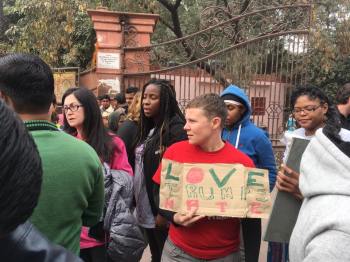
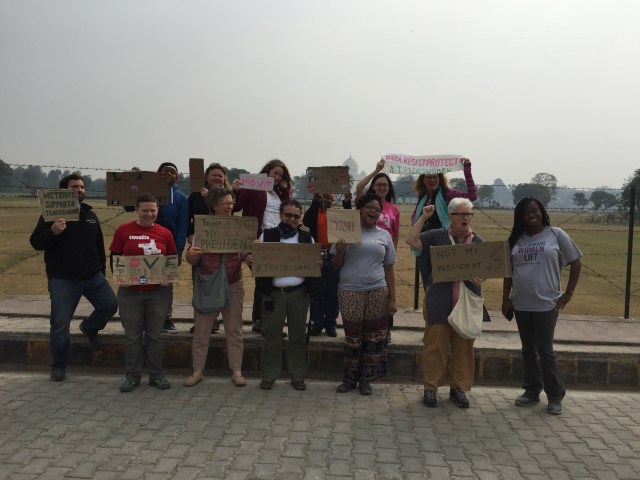
We were 15 citizens of the United States out of the country on the day that a dangerous and hateful person would become President. We never planned for this to happen. We never planned for the Presidential election to turn out the way it did. We are from all over the country- some from very conservative places where the resentment of deindustrialization and growing income inequality runs deep. Some know no one who voted for him and some have relatives and friends who did. But as union members, we were united in our opposition to the coming agenda of fear, misogyny and hatred towards immigrants.

And women all over the world would be protesting on a Saturday that we had free and where planning to visit the Taj Mahal. We decided to join the protest.

2017-01-21-07-30-55

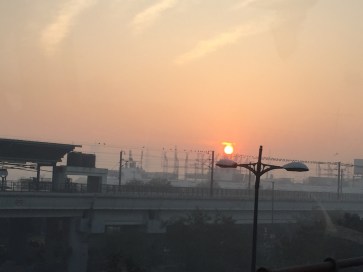
The day began with an “Indian hour and a half” road trip from Delhi to Agra, the site of the Taj Mahal. It took 4 hours. The sun was coming up and the sky was a haze of fog and pollution. I had not wanted to go to the Taj. I am a tourist snob and heard it was overrated, but the other Delegates has overruled me. Good decision, girls and Brian.

On the way, some of us collected scraps of cardboard from roadside tea stalls and gas stations. Someone had a couple of magic markers. We made our signs.

16174674_1778397615807897_7872304993715416072_nWe arrived at the entrance to the Taj Mahal late morning and it was packed with tourists and vendors. It was immediately clear that this was not the right place to protest. In addition to the chaos of the location, we were liable to draw police and that could cause trouble we were not looking for. We had (mysteriously) picked up a guide and translator along the way. By now he was getting the idea and he had us all pile back into the bus. We then drove around the city of Agra until we could see the Taj and have our protest without risking an encounter with the local police. We were a good mile away and the Taj Mahal was a tiny statue in the hazy distance.

Our audience was a few bewildered boys on bicycles and the world of social media. It was a perfect location.

2017-01-21-11-55-18

The First and Last Protest of The First Delegation of US Tradeswomen to India

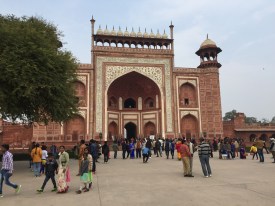
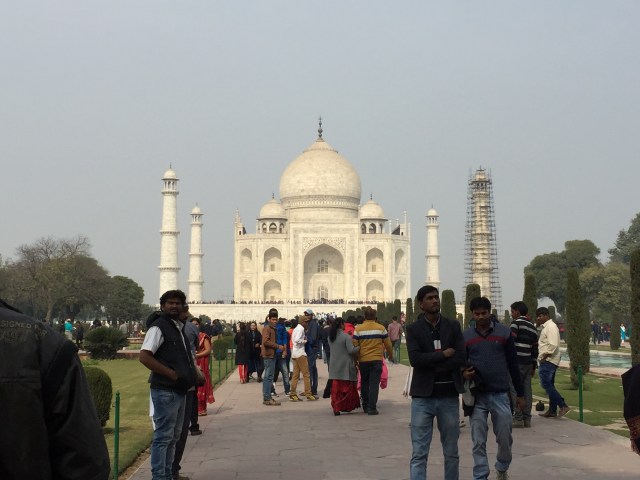
After our protest, we returned to our bus and went back to the Taj Mahal entrance to the monument. It is spectacular and beautiful. I was so wrong about not wanting to see it. No one who comes to India should miss it.

2017-01-21-13-06-07

The entrance

16174522_1778875892426736_7126594924025684018_n

Scaffold and repair work

It is a tomb for a lost love and a treat for anyone who loves symmetry and/or construction. It made a lot of us very happy. It was a Saturday and there were a lot of people there but it is so big that you don’t need to be in crowds. It is also spotlessly clean and vendors are not allowed inside.

It is very peaceful place and we had a terrific day.

2017-01-21-13-14-21


holly-smake-charmer

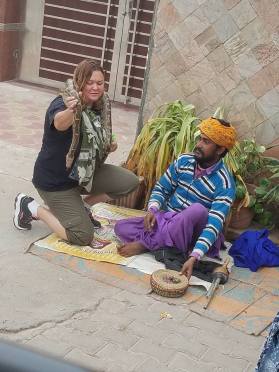
The day wasn’t over yet. We stopped to use a washroom before our long ride back to Delhi. While some of us were using the facilities, Holly got acquainted with a snake charmer. I don’t know exactly how it happened but she got even more acquainted with the snake.

It was a long day and a great day.

Love and peace.

susan


Posted in Uncategorized | 1 Comment

Our visit to a construction naka: We meet women construction workers

On our last day in Noida, the staff of VV Giri arranged a bus and a translator to take us to a naka, a village intersection where construction day laborers wait to be hired by contractors. This system is familiar to many in the US where urban immigrants – almost always men– wait for work on residential and small commercial construction sites. If you have not seen a naka in the US, check out the parking lot of your local Home Depot at 7-8 am. In the US and India, these workers are in the “informal sector” or the “underground economy,” meaning they are paid in cash and have no benefits or workplace protections. Several differences exist in India. The nakas are huge, highly visible and not hiding from the law. And, in the past, half of the workers waiting were women. This has changed recently and the number of women construction workers in India has dropped dramatically. As I described in my original proposal to Fulbright for this project, “women’s work” in construction, the so-called unskilled labor of materials moving and tending, is rapidly being mechanized and replace by technology. And a second and unforeseen change has accelerated the process of driving women from the industry. As Beth Barton, Tradeswomen Delegate and Carpenter from Kansas, will describe below, on November 9, the people of India woke up to demonetization. 

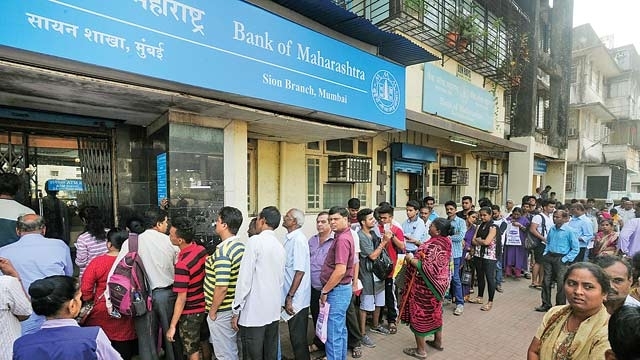
Imagine that tomorrow you woke up to find that the government had — overnight– declared that $10 and $20 bills were worthless and you needed to turn them in for new bills. (And there would be no more $20 bills, only $50). This is what the Government of India did on the night of November 8. I will leave you to google and wikipedia for the explanation(s) and the controversy, but one picture will give you an idea of the impact on the wider population.demon-queue

The impact on construction and construction workers has been devastating. Construction is a cash industry and 93% of its workers are in the informal sector. Construction has stopped all over the country, unemployment is almost total and women have been the first to go and hardest hit. During the Delegation’s visit, we met a couple of hundred women construction workers and found a handful– less than a dozen– working.

In this video of a woman laying brick, see the construction workers’ children in the background at about 20 seconds in.

This will provide you with some background and context for Beth’s story below of our trip to the naka and the amazing visit we had on a bus with ten unemployed women construction workers in Noida.

Love and peace

susan

20 January 2017, Noida, Uttar Pradesh, India

“This morning we went to a Naka, a corner where construction workers are hired for the day. What an experience. Twelve of us from the delegation with one interpreter all piled out of the bus on to the street corner where hundreds of Indian’s mostly male were standing. We followed Susan through the crowd looking for women workers.


When we found them, we began talking to them through the interpreter. Immediately swarms of men surrounded us, and we begin the slow process of trying to ask questions, then moving away to a quiet area to talk, only to be followed by the swarm of men. We moved several times and there were a few men who are very vocal and aggravated us as we talked to the women. I was pretty uncomfortable about it, I felt threatened. I didn’t like being at the center of 100 men’s focus.

At several points I thought we should all run for the bus, like when we were in front of the food stand, when Susan was yelling at the one men to leave us alone, I thought, “shit be nice so you don’t piss them off, because if they decide to get mad at us…” Fortunately, shortly after that someone had the great idea to take the women back to the bus, and the walk there was comfortable while we were being teased – or something like it – but it was hard to tell what the men were saying to me in a different language. I was so glad to get back to the personal space and safety of the bus. The women workers didn’t seem intimidated at all by the hundred men or so and proudly turned their noses up at them, taking our hands and walking away.

Once on the bus, everything was wonderful. The women were glad to come with us and asked if we could hire them for work. As we all sat on the bus with the 10 Indian women construction workers we began the process of developing who we were and what we wanted, and they begin to understand and started asking questions. The exchange of questions and answers began to form a picture.

Most of the women said they were single or widowed, all were from small villages in the state of Utter Pradesh. Most of them had not worked for about three months. The recent demonetization (removal of the Rs.500 and Rs.1000 bills in November 2016) has put a strain on the construction industry, which largely operates on a cash basis. The women said they usually earned Rs.200–250 a day, as compared to the Rs.400 male workers made. They were the last to get hired for work, yet these women seemed to be in good spirits. They were excited to be with us, and happy to answer any questions we had. I thought they would have reservations about getting on a bus with 15 strangers, but they didn’t. I thought anyone who hadn’t worked in months and looks like they hadn’t eaten much lately would be angry, but they weren’t. I expected them to be utterly defeated in spirit, but they weren’t. These beautiful, strong women were energetic, and lighthearted, and spirited. I didn’t need a translator to feel a strong connection to them, and I felt like they were feeling it too.

I was so humbled. These women are my idols. I wish I could be more like them. I wish we could’ve kept them with us, and brought them home to America, to give them all good food and jobs. But since we couldn’t do that we put together enough money to give them Rs.300 each [to compensate them for the day’s pay they missed by getting on the bus with us], and drove them away from the crowd, and they got off the bus. They were excessively grateful, passing blessings over each one of us. Saying goodbye was sad. I didn’t want to leave them without a solution. I am hoping the rest of the trip we will build a network to connect the right people and start to change the plight of these women. I want to bring hope to them, as they have brought hope to me. Thank you women construction workers in India!  I deeply appreciate the opportunity to have met you!!”

—Beth Barton, UBC Local 1596, Board President, Missouri Women in Trades (MOWIT)


Posted in Uncategorized | 1 Comment