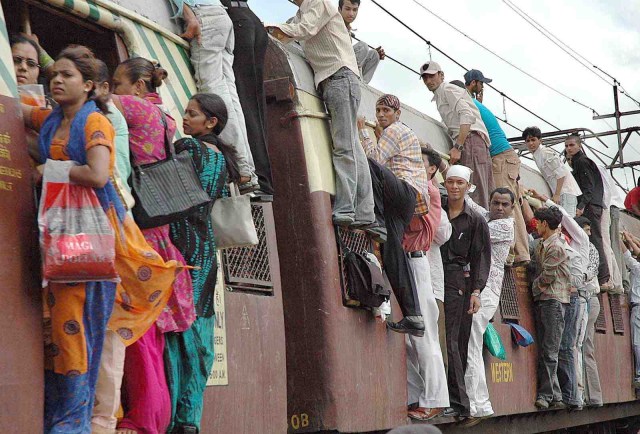
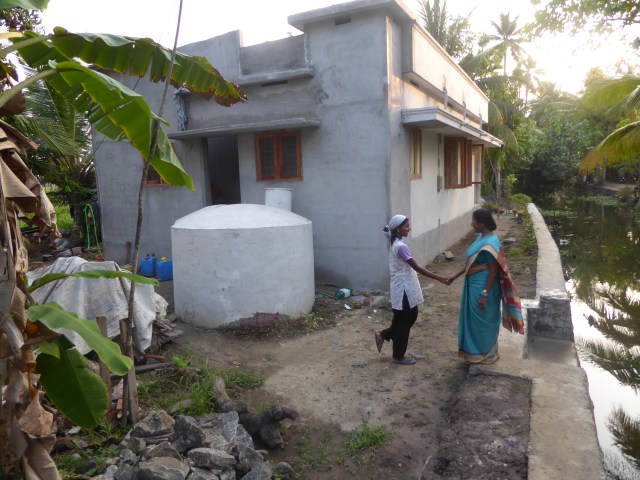
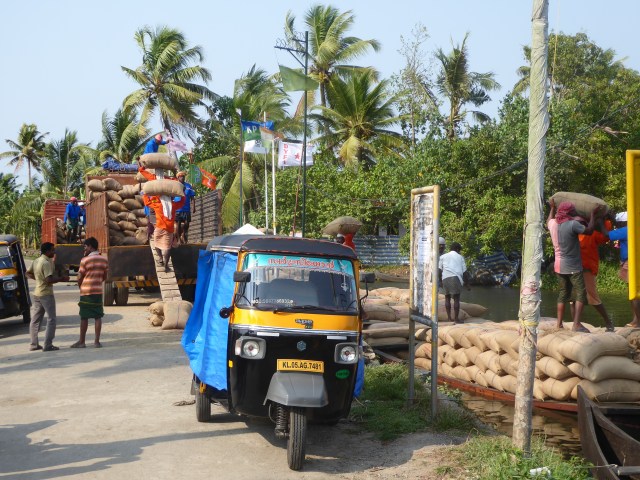
A visit to M-Ward

I am in the library working – struggling –with two presentations I will be making on Thursday and Friday. The first is on my research here on women in construction. I will be presenting to Women’s Studies students. The second, by request and to a larger group, is on the US labor movement. I have titled it, “The Peculiar History of the Labor Movement in the United States.” I say ‘peculiar’ because, with the absence of class consciousness among American workers, why do we have any unions at all. And will we have any unions at all when Friedrich v. California Teachers Association is decided by the Supreme Court in the next few weeks? Anyway, that’s depressing so I thought I would share my day in the Mumbai slums.

And that is the last time I will use the word ‘slums.’ The poor of Mumbai live in settlements, resettlements and nagars (nagar: a town or a suburb). Their homes are nearly entirely self-constructed from found materials. But over time, people pour concrete or use bricks and build permanent housing and then, like my grandparents did, they build up and out. On Tuesday of the past week, I went on a tour of Mumbai’s M-Ward that was sponsored by the conference I was attending on Rethinking Cities in the Global South. Mumbai is divided into administrative districts designated by letters of the alphabet. M-Ward has the lowest Human Development score, which measures health, education and income, of any place in Mumbai.

TISS, where I am living, is located in the M-Ward and has had a long time partnership with residents and organizations. They have an 8 1/2 minute video, M-Ward: From the Margins, that is better than any pictures I took.

I will tell you about what I saw and who I met.

First we went to Cheeta Camp. We went to one of the settlements’ schools and met with community activist Abul Hassan. Classrooms are around a large center courtyard. Chairs were set up for us to sit in a circle in the courtyard and talk with Hassan. We were not there long when bells rang, children from all directions cheered and the courtyard filled with kids on their break. Many stood around the circle and listened, some played games including the ubiquitous badminton.

Cheeta Camp has about 110,000 residents and 11,000 households. They have 14 schools and 95% school attendance. Some kids go onto higher education and go to work in call centers. Some become laborers and migrate to the Gulf to work. This settlement has been moved at least twice since 1950. They were originally in many areas in central Mumbai but were forced out when their land became valuable. They were moved to Janta Colony, a marshy area near the docks where they became the dockworkers. After 25 year, they were forced to move again. However, the government determined that only a small share of the residents were entitled to resettlement (lots of legalistic bullshit about who has some land rights and who has no rights), but the community created what Hassan called a Mighty Alliance and refused to move without everyone. The alliance prevented any single political party from cutting deals for their supporters and the residents engaged in civil disobedience. They won and all the residents moved to their current location. They continue to fight for legal title to the land and continue to be threatened by government and developers who see the land as having increasing value. You can see the contrast in the photos where some residents have been able to make improvements in their streets with tile and a roof that makes a very big difference in monsoon season.

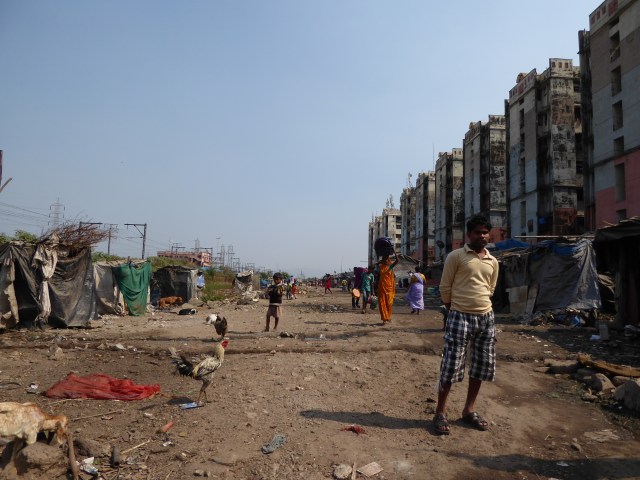
Maharashtra Nagar Transit Camp is not so settled, not so unified and its residents are living in substantially worse conditions. Seventy-six thousand people live there in 5850 households. The oldest part of the camp is ten years old. The camp spreads along open fields for about a half-mile. The end nearest the main road has electricity but none of the residents have running water. Water must be carried from a great distance. There are no toilets and residents use the field across from the camp. There is only one school and no health services. There is a pre-school in the camp but residents said that they resell food that they have received for the kids. (If you have not read Beyond the Beautiful Forevers, I recommend it. Small handouts to very poor people do not help and do perpetuate divisions among neighbors.)

But there are community leaders in the settlement and they are organizing. They are part of the Make Your House/Save Your House campaign and the citywide people’s movement to secure the right to housing for all.

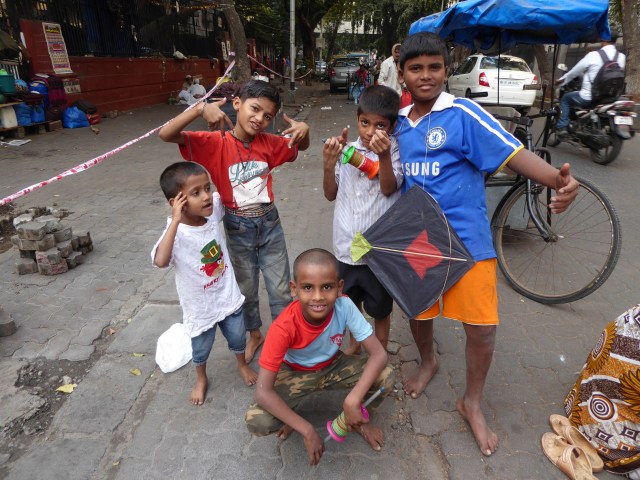
The best time I had in Maharashtra was in a section that is built along a trench next to the railroad tracks. The small shacks on the left are the toilets people have built. The city and/or the railroad will come along regularly and bulldoze them down. Then people rebuild them. The tarp on the right are the residents homes. The buildings are nearby apartments.Transit campThis settlement seemed to belong to the women and children. The kids followed us and asked questions in English, “Whose your mom?” and copied our answers. “Dorothy.” “Dorothy!” from a chorus of 7 to 8 kids. Me: “But she died.” “But she died!” “Whose you dad?” “Henry, but he died.” “Henry, but he died!” The moms invited us into their homes and offered us sweets and desserts. We all had a very good time together.

Our final stop was at Mandala where the women welcomed us with garlands and anointed our foreheads with bindis.

The men took over to tell us the story of the 16 year old camp which is very well established with 1200 homes and a commercial area. But they still battle the government for land rights, water, sanitation, electricity and education. The final speaker, Ateek, was the young—or maybe not so young—lifetime guy organizer we all know, sometimes get annoyed by but love all the same. Not listing them by name but I am tempted. He taught us the Hindustani call for collective action in the settlements and maybe among social justice activists everywhere. Zindabad! the community orgnaizer

Our very able guides on the tour, Richa Bhardwan (I think) and Purva Dewooklar, who works at the M-Ward Initiative at TISS. My thanks to them and to Leena Joshi for an education in the settlements of Mumbai.

M Ward guides

Richa Bhardwan and Purva Dewooklar

Posted in Uncategorized | 5 Comments

Jan 18- My MLK Day in Mumbai

I am still unsure of the balance of the personal and the political here on my blog, but I am clear that the main purpose is to document my research on women in construction in India—my fieldwork, in the lingo of my trade. That might get tedious for you. I have witnessed the glassy stares of loved ones as I have passionately described the intricacies of implementing and evaluating best practices through multi-stakeholder partnerships. I lost the attention of more than a few a couple of months ago when I compared the Policy Group on Tradeswomen’s Issues to the Tunisians who won the Nobel Prize for Peace.

So my thought on this at the moment is to put headers on sections so you can know what is coming and skip it if you like. I like to report chronologically and not topically and that means you could be reading an interesting—to all, I think—story about the cab ride I took this morning, followed by some notes on housing and research paperwork at TISS (the Institute that I am affiliated with) and then a meeting I had the Dean of the Social Work School.

So here is what happened today.

My morning cab ride

This was my first day going to TISS, the Tata Institute for Social Sciences, the university that is hosting me. I went to meet Jennifer at the International Office to get my paperwork going for my official research status with the Indian government (all called FRRO). TISS is in Chembur in the northeast section of the city and I have been staying in Churchgate in south Mumbai. It is akin to going to Queens from Lower Manhattan. I could take the bus or train but the bus is slow and the train involves a couple of changes so I decided to get a cab. The first two taxi drivers would not take me. I was not sure if they knew where Chembur is, but I remember when I drove a cab and did not want to take a fare to someplace distant where I would not get a fare back. It is like being paid for half the trip. The third driver said yes and off we went—for about five minutes. This was about 10 am and that is heavy rush hour because the Indian business day starts and ends later than the US. Something very ordinary happened and then something extraordinary. The ordinary thing is the driver went through a red light and crossed in front of a line of oncoming traffic complicated by about 30 pedestrians crossing in the street at the same time. The extraordinary thing was that a traffic cop stopped the driver and waved him over! The driver then started screaming at the cop and tried to drive away but had nowhere to go. As the traffic ahead moved, the cop stood front of the cab. The driver inched forward, the screaming continued from both cop and the driver, and then the driver cut across three lines of traffic and pulled to the side of the road. The left side. I am still getting used to that. Screaming recommenced unitl the cop walked away and then the driver got out and followed the cop. He turned back once, took the key from ignition and told me to wait. That is the end of the story. I waited a couple of minutes then got out of the cab to see what was happening. Neither the driver nor the cop were anywhere around. I tucked Rs.25 into the meter and went looking for another cab.

I got to TISS about 11 by way of a very unusual driver who actually asked directions twice.

New Place to Stay

I did a lot of paperwork with Jennifer, Zuzubee and the staff at the International Office. They were very helpful and gave me a really nice TISS bag. I am moving out of the downtown hotel on Wednesday and into the hostel at TISS. By “hostel” I mean the girls’ dorm. Triple room so I may have roommates but the most exciting part is that there is a locked cabinet where I can leave my big bag while traveling.

Made three new friends. Hannah, Batseba and Daniella are Swedish undergraduates studying social work who are at TISS on a semester abroad. We had a tour of the campus and—jumping into the future—will take a trip downtown on Wednesday to get our research permits and do a little shopping in the Fort.

Vocabulary interlude: A “chowk” is a square, as in Harvard Chowk or Trafalgar Chowk.

Figuring it out as I go

I am writing this two days later. Two thoughts:

  • It is always hard to find time to write—no easier here.
  • I have changed the tab “Evolving research questions” on the blog to My Field Notes. I will give a heads up in the blog when some readers might want to check out how my field work is going., but I will mostly use the blog function for reflection—like I am doing right now!

Meetings with two professors

Joined Heather Ridge in two very good meetings with faculty members: the Dean of the School of Social Work and the Dean of the School of Management and Labour Studies. The latter is where I am affiliated. I got a lot of information about how TISS operates and good leads for interviews. Details can be viewed—soon I hope—in My Field Notes.

An Ugly American mistake

I forgot it was Martin Luther King Day on Monday and there was no reminder here, nothing in the morning paper, no one mentioned it. I did not remember. I was reminded when I went on Facebook later. Of course Indians do not acknowledge, or even have knowledge of, MLK Day. However, my inner American exceptionalist was still surprised. Not logically, but emotionally. Another lesson learned.

The next day- Tuesday, Jan 19—I participated in a field trip, “Making Homes in M Ward Mumbai: the City’s Dumping Ground.” That’s the next post with pictures.

Love to all.

Posted in Uncategorized | 8 Comments

Day Two: What’s it like? How’m I doing? Where’s my stuff?

This blog was created to report on my research. It was in my proposal to Fulbright in response the question of how I would make my work known to others. I could not decide before I left if it would be strictly research or also my personal experiences while being in India for three months. I still can’t decide, but today I have decided that I would like to share some thoughts about the three questions above with my family, friends and community. Or maybe I have decided.

I have been here for less than 48 hours. I know it but it can’t be true. You know the theory that time is slower when we are young and speeds up as we grow? The idea behind this is that the more stimulation we are receiving, the slower everything seems and as we age and newness recedes, time goes by. Songs have been written and time, for me here and now, is nearly at a standstill as all I see and hear is new and unique to me.

What is it like?

Today is Saturday and the streets and parks are full of temples and cricket. Sounds of drums, crows and car horns. My hotel room is in the back and five floors up. It is quiet at night. The crows are different, beautiful and everywhere. People walk in the street because the sidewalks are too crowded, someone’s home or popup shop, or just not there. Horns blare constantly as drivers honk in anticipation of the green light, to let pedestrians know they are going to run them down, to move a car over another foot so that three cars can fill two lanes. Motor bikes pay no attention to traffic rules such as lights or one-way streets. It is not true that everyone speaks English. Not true that most people speak English. Cab drivers, clerks and vendors, staff at the hotel, understand a little, but we are communicating through universal sign language and willing bystanders who see the predicament and step in to translate. Four people helped me get a cab an hour ago. Earlier, I asked two men sitting/working in a park for directions. They were unable to help me, but a minute later, an older man came up behind me and asked if he could help. He showed me where to go and said it was his duty to help me, “his elder sister.” I went into a café for chai and, only after taking a table just inside the door, did I realize that there were all men there and women sat upstairs. No one bothered me, just my mistake for not paying closer attention. Again, the stimulation can be overwhelming.

How’m I doing?

I am doing very well although I woke up scared this morning. Only two days gone and three months to go, but I know I will settle in and it will be fine. I am exploring my neighborhood a block at a time. I just keep taking rights until I get back to the hotel. Today I made it to the ocean, the Arabian Sea. It was midday and very hot so I had to head back to the neighborhoods for shade. I automatically stay to the right when walking and that is wrong because walking and driving are on the left. I have a technique for crossing streets: get into the middle of a crowd and just go with it. But don’t fall out of the scrum or you will be standing in the middle of the road with traffic whizzing by.

I have been twice to the khadi emporium. Beautiful clothes made by fabric made and dyed in the villages. This continues Ghandi’s movement for the economic and spiritual benefits of spinning and homespun fabric. I thought I might go to the museum today but it was too ambitious. Got my culture fix by shopping instead.

I found myself at the train station early this afternoon. Walked off the end of platform like everyone else and crossed the tracks to get to a southbound train that had just pulled in. Mumbai is a peninsular and there is nowhere for a southbound train to go so I thought I would just take the train to wherever it went and take a cab back. Second thoughts can be good because, while I was mulling this idea over, the train pulled out of the station going north again. The station is the terminus of the line and I have no idea where I would have gone if I had gotten on that train.

I am still figuring out food. The hotel serves breakfast and that is my only regular meal so far. I am following the advice to not eat street food, but that makes eating complicated as that is how Mumbaikers eat. I know there are restaurants somewhere but not so much in my part of town. I search for bananas and today I went to Starbucks for a predictable meal—hummus and pita—and a cup of Earl Gray. It was a nice break.

Where’s my stuff?

This is my biggest challenge. By vocation and habit, I am an organizer but not organized. Now I am carrying all my stuff for three months on my back figuratively and in three bags literally. My natural impulse is to buy more bags. But I know this is oh so wrong. So I search… for the camera, the money, glasses, medications, passport, a pen, the phone receipt I suddenly need, the box for the phone I should have had when I returned to the store and now have to go back a third time.

I don’t know if I will solve this or not. I am keeping my expectations very low. Today I made small improvements. I will not carry more than 2 pairs of glasses at a time (reading plus sun OR not). I exchanged all my US money for rupees so I only have to keep track of one currency. I am packing up and stowing the last minute clothes I packed out of panic but will not wear. Will probably just give them away when I get a chance.

Where is my stuff will be an ongoing issue because I will be moving often. I will leave the West End Hotel in another 5 days when I move to a B&B in northern Mumbai. In the meantime, I soak up the opportunity to experience time as a child does, filled with newness and excitement.

Love and peace to all.


Posted in Uncategorized | 15 Comments

Day One

No problem finding women working in construction in Mumbai.

These women are digging a trench right outside my hotel in preparation for pipe work. They appear to be family units. The women work in the trench shoveling and removing cobblestones and dirt. The men work the pike loosing the materials. The workers spoke no English. The woman in the blue sari on the sidewalk spoke a bit. She seemed to be the supervisor. She wants 10 rupees apiece if I want to talk with them tomorrow. I might try to find a translator. They were still working when I went for a walk at 7:30 tonight. Not sure if these kids are the workers’ but they could be. They were at the site all day. Maybe the workers children or could be part of the many families that live along the side of the rode.

P1000616

Posted in Uncategorized | 12 Comments

Islands Within Islands

This is awonderful piece of writing on Mumbai. Heather is a fellow Fulbrighter. She is a voc tech teacher from Boulder so we have at least two connections: my interest in seeing more young women in voc-tec going into the skilled building trades (“more power tools, fewer hair dryers”) and Harneen is from Boulder. Heather and I will have a lot to talk about when we finally meet on Sunday for a Bird and Bat Tour of Elephanta Island.

heatherriffel's avatarTeacher Without Borders

Mumbai’s first residents were thought to be deep-sea  fisherfolks, called the Kolis, who lived on what were originally seven islands along the shores of the Arabian Sea.  Over the centuries, Hindu dynasties, Muslim conquerors, Portuguese and British trading companies, and eventually the British government filled in the spaces in between- both figuratively and quite literally, through land reclamation projects. The seven islands are now joined into one continuous land mass that boasts 20,694 people per square kilometer. For comparison, New York City hosts about 10,760 in the same space.

mumbai-final

Since we arrived one week ago, I feel like I’ve spent much more time adjusting to the staggering “urban”-ness of the city than the “other”-ness of the culture.  Trade-offs, really.  In a city as cosmopolitan as Mumbai, there is such a mix of people, language, and experience that it almost has its own nationality, like the city-state of Singapore (which…

View original post 583 more words

Posted in Uncategorized | 1 Comment

24 hours to go!

I will be finally on my way to India at 8 PM tomorrow night. I am very excited, but some of my closest people are anxious because they have not received notices of any posts on my blog. That is because I have not posted in weeks, time taken up with packing, unpacking and repacking. I am ready now.

Dhanyvaad, David Bowie, for inspiring a couple of generations to be more than we could have imagined, for teaching us to push boundaries.

Dhanyvaad to my family and friends for all your support. Dhanyvaad in advance to all the new friends I will be making in India.

Posted in Uncategorized | 1 Comment

What will happen when highly capitalized global construction firms enter the Indian market?

There are many reasons that women do the heaviest and dirtiest work in the construction industry in India. One is that , right now, women are cheaper than machines. But global companies come with capital and machines. As bad as the jobs are, what will women do if these jobs disappear? Here is a story about the merger of a small Indian firm with a Chinese megacompany to do the work that is being done by women in the accompanying photo.

 Women repair a road in Umaria district, Madhya Pradesh, India. (Yann/Wikimedia Commons)

Women repair a road in Umaria district, Madhya Pradesh, India. (Yann/Wikimedia Commons)

Posted in Uncategorized | Leave a comment

When power speaks truth, or What is policy anyway?

I receive a daily news digest for anything that crosses the internet with the terms “India,” “women” and “construction.” Today I received “A peek into the lives of women construction workers.” The article has lots of pictures and tells the too typical stories of Devamma and Padmaja, women who have migrated from their villages to the cities for work in construction. They do the heaviest and most dangerous work and are paid the lowest wages. They live on or next to the construction sites where they work and are exposed to all the environmental hazards all day every day. Devamma’s children are with her and also exposed to the hazards.

I am always curious to look into who is publicizing the conditions of India’s women construction workers. This is the first time I have seen this site, Jaago Re, and was surprised to see that it is owned by Tata Tea. It seems to be a both a feminist cause site (“the Power of 49”) and a tea marketing site (“Drink Tata Tea!”).

So I am skeptical. This seems to take the dubious concept of social marketing to another level. But I love their tagline/mission statement: “No fundamental social change occurs merely because government acts. It’s because civil society, the conscience of a country, begins to rise up and demand – demand – demand change.” The organizers reading this are saying ‘duh’ but the policy people may be confused. Relentless efforts to persuade bureaucracies to begin to do what they have never done do not work, regardless of the good intentions of the bureaucrats or the policy advocates. Tata Tea and Frederick Douglass agree that “power concedes nothing without a demand. It never did and it never will.”

Posted in children, construction, women | Leave a comment

“Why toddlers are on a leash in Delhi”

From the Times of India today, national laws, such as the Contract Labour Act, the Building and Other Construction Workers Act and the Inter-State Migrants Act, have childcare provisions for women working in construction. Mobile Creches have been available on some large construction sites since 1969. However, many women work on small jobs that are not covered by the law and where there are no childcare options. Parents are left to tie their small children nearby to keep them safe.

http://timesofindia.indiatimes.com/city/delhi/Why-toddlers-are-on-a-leash-in-Delhi/articleshow/48979555.cms

Posted in children, construction, mobile creches, women | Leave a comment

Kudumbashree: Kerala’s all women’s construction company

This is a terrific video by the BBC on the Kudumbashree Construction Companies. “Kudumbashree” is the southern Indian state of Kerala’s mission to wipe out poverty through community action and the empowerment of women. The literal meaning of Kudumbashree is prosperity (shree) of the family (Kudumbam). You can see more on the government policies and projects at http://www.kudumbashree.org/?q=home.

The Archana Women’s Centre in Kottayam is one of the training centers for the Kudumbashree workers. I hope to be there for International Women’s Day 2016.

Posted in construction, Kudumbashree, training, women | Tagged | Leave a comment