India: Research and Reflections

Please join me for on May 5 as I share my India adventures with you.

Susan Moir, Director of Research at the UMass Boston Labor Research Center, has recently returned from 3 months in India. Join us for Indian food and Susan’s report back on her Fulbright sponsored trip. Be the first to hear plans for next year’s planned “Building Bridges: The First Delegation of US Tradeswomen to India.

Thursday, May 5, 6-8 PM

At 1199SEIU, 150 Mt. Vernon St, Dorchester, 2nd floor

Please RSVP to tradeswomenbuildingbridges@gmail.com

Posted in Uncategorized | 1 Comment

Goodbye to India for now

At 3 am tonight I leave Mumbai and India. I will be home at 3 pm Thursday. I am very glad to see my family and friends and dog, to sleep in cool weather and get back to work that I love and a community that has supported and nurtured me through some miraculous transformations and opportunities.

And I will miss India. It has been the most fantastic and fun adventure. India is so complicated and challenging, so different from my home, so rich in its culture, politics and people, almost indescribable. Mumbai is noisy, full of trash and in a state of near anarchy. The city is often dubbed “vibrant.” What an understatement. Twelve and a half million people live in Mumbai. It has double the population density of New York City, but consider this. Mumbai’s population is horizontal. There are almost no skyscrapers and few high rises in most areas. Everyday Mumbai is like Times Square with 24-hour rush hour traffic. New York is Clark Kent to Mumbai’s Superman.

The people of India have been described as argumentative. To a non-India language speaker … well, there are 700 languages so the first question may be which am I hearing. An overheard conversation between friends or co-workers that sounds like conflict to an outsider could be just passionate opinions. Those of you who know me well can probably understand how very comfortable that can make me feel here. People are amazingly well informed. We have four daily English language newspapers delivered to our hostel every day. There are more daily papers in Hindi and local languages.

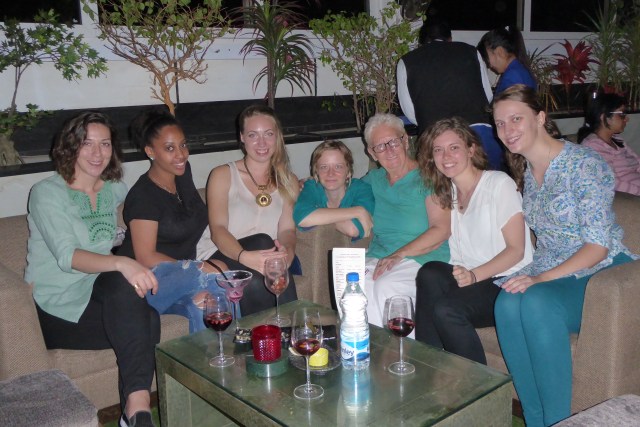
I was so lucky to almost accidentally find the Tata Institute of Social Sciences (TISS) and, with the assistance of the Fulbright staff, to be able to affiliate with the Centre for Labour Studies and the Advanced Centre for Women’s Studies. The campus is small and the curricula progressive and focused on social change. The school practices aggressive affirmative action and the student body and faculty reflect the great diversity of India, especially by caste and gender. On any day, at a meal, in an elevator or just walking across campus, I have had wonderful and informative conversations on social conditions, politics, global economics, migration, poverty and patriarchy. I have watched and played cricket, learned and got beat badly at a board game called karoom. I attended yoga and Hindi language classes. I have lived in a dorm– in a triple– with a great group of women less than half my age who have become my friends. We have had long conversations about India and our work here, what it is like for an outsider, what we love and what we find confusing and/or difficult. We have eaten many meals together in the dining hall, local restaurants and last night in a rooftop bar. I have been the dorm mom and they have taught me modern heterosexual dating rituals.

P1020050

Konstantina, Batseba, Mia, Hanna, me, Mirjam and Eva

Indians have a custom called adda. It essentially means taking the time to sit and just talk about serious and worldly issues. It does not mean setting up a meeting or even making a date to talk. It means stopping to talk now. Adda is one of the gifts from India that I want to take home.

Traveling around the country by myself with limited to no language skills was often difficult. I have been to nine cites while being very bad at India’s transport systems. I have missed trains and tried to board one when I thought I had a ticket but actually did not. I have paid outrageous cab fares on many occasions. I took an all night bus ride that was so noisy, bumpy and cold I hardly slept. When the driver yelled, “airport” I got off in a haze and then realized I was in the middle of nowhere at 4:30 in the morning and I really had to pee. I have been embarrassed at my screw ups but I console myself by remembering that my research has gone really well and I can’t be good at everything. And eventually I always go where I was going.

I am not romanticizing India. It is a very tough place. It is no vacation—except in the vacation oases where tourists and beggars share a symbiotic economy. To live among the people of India is to observe pervasive poverty and experience endless chaos. But I have also been witness to liveliness, an engagement with life that I do not see in the place I call home—the place that Indians call America no matter how many times I say I am from the United States. “America is a dream and a continent.” I explain. “The United States is the place that sells arms to both India and Pakistan.”

I am so lucky that I will be returning to India next January. The second part of my Fulbright fellowship will focus on building an international network by and for women working in the global construction industry. I will continue to post here on that and other subjects, sometimes not sequentially as I have a lot of material form this trip that I will be writing up over the next few months.

I thank you all for following my travels. I appreciate comments if you have time.

For those at home, see you soon. For those in India, see you in January 2017. For my “Swedish” girlfriends, stay in touch.

Calling my flight. Off I go.

Love and peace

susan

Posted in Uncategorized | 7 Comments

Equality for girl children

I had a fun and interesting couple of days in Pune hosted by Shraddha Borawake, photographer and new relation by marriage to my old friend, Nancy Falk. Shraddha did a project on women in construction some years ago and we are exploring future collaboration. My favorite of her short films is “Will You Wear the Pants?” This past Tuesday, we sat down with Shruti Purandare to find out more about the work of Tara Mobile Creches Pune. TMCP is one of the organizations in India that is providing child care for the children of construction workers– an area in which India is far ahead of the United States.

One of the most hopeful things I have heard since starting my research was from Shruti. Construction is a family business here and the workforce is very mobile. This makes it difficult for the children to continue their education. It is doubly difficult for girls who are expected to take on household responsibilities at a very young age. TMCP has a program for kids of construction workers to continue their education in residential schools and this year, for the first time, they have more girls entering the program than boys.

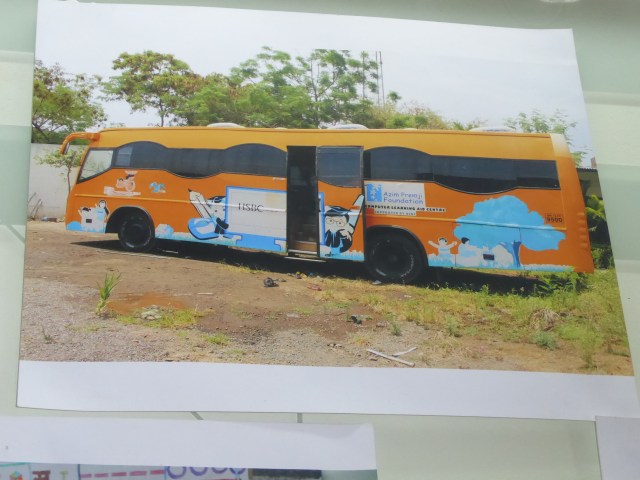
Another amazing thing that TMCP is doing is this mobile computer lab that is introducing kids in construction families to computer skills.

2016-03-22 13.04.05

I am WAY behind in my field notes online but you can see more details of our meeting with TMCP in the Field Notes tab on my home page.

Shraddha, Shruti and me at the Tara Mobile Creches Pune office.2016-03-22 13.00.56

Posted in Uncategorized | 1 Comment

To the Moirs: Walking in Uncle Fred’s Footsteps

To my cousins, children, nieces, nephews and all other Moirs,

You remember when Auntie Elsie died and I received five big boxes of her stuff and we held the Holy Yard Sale in my yard in Jamaica Plain and I made you take home rosaries and holy statues, a lifetime of possessions of a wonderful woman and terrific aunt who was in the convent for almost 50 years before she left and moved to Florida with her girlfriend?

I kept a couple of things.

One was a metal box of papers. When I finally opened that box a few years later, I found 36 letters, most of them from our great Uncle Frederick to our great grandparents in Cheshire outside of Liverpool, England. Fred was a sergeant in the British Army and he was stationed in Bangalore, India when he wrote the letters between 1911 and 1917.

Let me tell you a couple of things about Fred. He was a sketch artist and cartoonist. The letters include a couple of his drawings and references to sketches he had published in Indian newspapers. He was engaged to Mill in England, but broke off the engagement when he fell in love with Miss Marjorie Lee in Bangalore. Marjorie was Anglo-Indian, not the mixed race meaning of that term, but the other meaning. She was born in India and I don’t think she had ever been to England. Fred tried very hard for several years to get out of the infantry and into Supply and Transport. He was unsuccessful and in 1916, he was shipped out, first to Alexandria Egypt and then to Mesopotamia. The last three letters from Marjorie and her mother are to our great grandparents and to another Elsie, our great aunt Elsie Rawlinson. We learn that Fred and his best friend, Robinson, were killed within a couple of days of each other in Basra, Mesopotamia in February 1917.

I brought copies of the letters with me to India in hopes that I would get a chance to go to Bangalore and walk around where Fred might have been. I put the trip off because I did not really think I would find any traces. Bangalore is India’s most modern city. But then an opportunity happened and I went there Thursday afternoon.

I was very surprised when I reached the city center to find the infrastructure of the Raj (the British Empire in India) intact, beautiful and still in use. I came into the center on Infantry Road and thought, could Fred have lived here? The next thing I saw was the Post Office and I thought perhaps Fred mailed his letters from here. One of the letters is from Hugh Lee (Marjorie’s father?). It is during the war and he tells Fred that there is a position available for him in the Post Office, but he needs to hurry back because the job cannot be kept open for too long. A little down the road past the Post Office, today’s State Assembly and Courts meet in buildings Fred might have entered.


Behind the Courts is a beautiful park, Cubbon Park in Fred’s time, now named Sri Chamarajendra Park. Would Fred and Marjorie have walked through Cubbon Park? Maybe gone to concerts at the bandstand.

We know from the letters that Marjorie and her family lived on the Residency Road. It was very hot so I decided to take a tuktuk to Residency Road. Just as I got in we passed a Police Station that Fred would have walked past. A few minutes later, we rounded a corner and there was the Cantonment—the military area established by the British military. This is where Fred would have worked.  Since independence in 1947, these are the sites of the Indian Army. Speeding past the cantonment in the tuktuk, I spotted the office of the Supply Depot, the office where Fred sought to be transferred, the position that might have saved his life if he had received the transfer. Across the street was the parade ground where troops would have mustered.

I had the driver drop me off at the end of Residency Road. Big mistake. It was crammed with traffic and construction and there was nowhere to walk. Looking down the street, I could see that Residency Road was all new buildings. But then I saw an old one. Now a pretty shabby hotel, this would have been a shiny residence in the 1900s. Maybe Marjorie’s home? Further on there is a suspiciously crossless Catholic Church. It could have originally been the church that the British of Residency Road attended. It would have been High Anglican, the Protestant denomination that Fred’s brother, our grandfather Jack, left when he converted to marry Nana.

I needed to get out of the traffic and onto a sidewalk. I headed toward an intersecting street across a little park. And then I saw the monument—a monument to the British and Indian soldiers who died in World War I. And on the side that I was facing, it said “Mesopotamia,” the theater of war where Fred served and died, today’s Iraq. In English and Kannada, it honored not only the British and Indian officers, but also the NCOs (non-commissioned officers). Fred would have been an NCO.
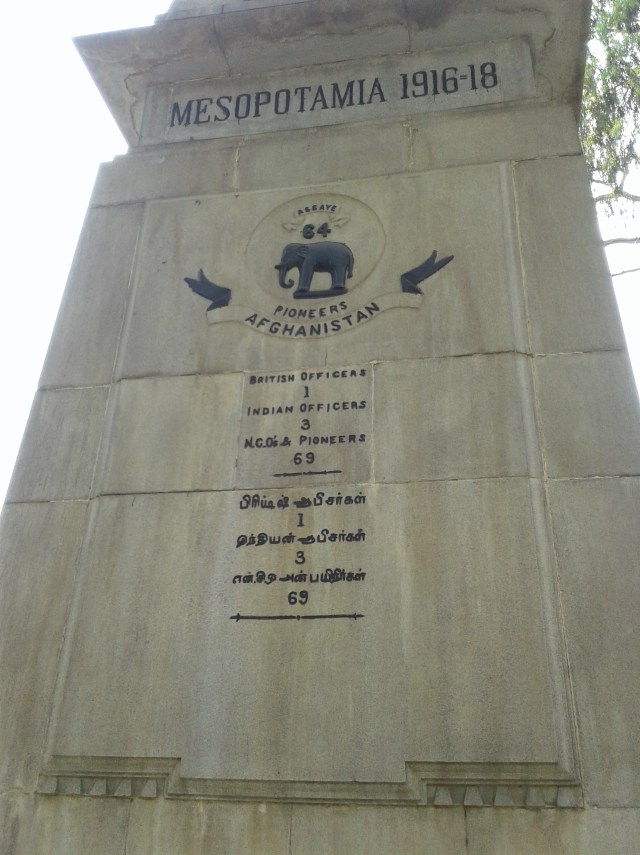
monument

I burst out crying and stood sobbing on the sidewalk. I told the street vendor standing beside me why I was crying. He was kind in a way that Indians are although he had no idea what I was saying. After a few minutes, I walked around to find the gate into the little park. A guard came to stop me, but when I showed him Fred’s letters and explained why I wanted to get closer, he opened the gate. He stood near me as I cried and took some pictures.

You know, my cousins, that I have spent my life fluctuating between peacenik and socialist. I am not proud that my relative was part of an occupying army. And I am not ashamed. It just is what a working class guy with no prospects might have done at the turn of the twentieth century—or the twentieth-first. And on the 100th anniversary of the Easter Rising, let us remember that Nana’s people in Ireland were living under the other end of British imperialism.

Like many before and since, our Great Uncle Fred was the fodder of war and paid the price. I am proud that we can remember him as a person and that his memory is recognized in the city where he found love, the city that was his home.

Posted in Uncategorized | 8 Comments

Two days in Kerala

I am traveling so much, learning so much and I am so tired. I have not had time/energy to organize pictures, words or thoughts. Tonight I am in the airport in Cochi, Kerala waiting for a late plane to Bangalore. Let me show you in pictures how my last few days have been.

A little over a year ago, I learned about the Archana Women’s Center in Ettumanoor, Kerala. They had a big Women’s Day Celebration featuring the training programs in masonry and carpentry that they have done for women. I hoped to visit the Centre while here but it did not look like it would happen until I met Renu Varughese at the Fulbright Conference in Jaipur a couple of weeks ago. Renu is from Kerala and when I told her about Archana, she offered to go there, see if it was real and ask if they would meet with me. She met Miss Thresiamma Mathew, Director of the Centre, and arranged for a driver, Mr. Binu John of Hebron Travel, to pick me up at the airport and take me to a nearby hotel. (Just for some geographical context, it is about 1000 miles form Bombay to Kerala, like traveling from Boston to Atlanta). On Tuesday, I took a tuktuk from the hotel to the Centre and had a wonderful day with Miss Mathew and the women of Archana.

Here are some pics and people I met.

Miss Mathew and the Archana Women’s Centre staff.

A focus group with masons Binababu, Ponnaamma and Ancyshaji. They are out of work for a number of reasons related to health and the depressed construction economy in Kerala.


The concrete block workshop at the Centre.

The woodworking workshop in another village.

Carpenter Omenah has studied interior design and has been making kitchen cabinets, wardrobes and doors for a nearby home.

Off to the backwaters to see the Yaradhaka’s house that she, Valasala and Umadagal are building. We took long wooden canoes to Yaradhaka’s home where she lives with her husband and to children.

Umadgal was not there that day. Valasala went back with us and we went to the home she built and lives in with her family. 2016-03-16 17.43.10

Some backwater scenes:

These men are loading paddy rice that has just been harvested. From boats to lorry.2016-03-16 15.58.56

This man is “herding” his ducks back to their home after they feasted on the paddy rice.

This woman is eating a coconut.2016-03-16 16.55.59

On Wednesday, Miss Mathew arranged for me to go to Thrissur- a 4 hour ride north with Binu- to see the Jeevapoorna Women’s Mason’s Charitable Society. This is a brick and tile workshop owned and run by women. They also run a canteen on the property which is the neighborhood’s favorite lunch place.

Annie Joseph and the mason’s of the Jeevapoorna Women’s Mason’s Society.

The women make concrete bricks and specialty tiles.

Binu was my driver and translator. If you know anyone traveling to Kerala, he can be reached through his website. Excellent service and we had a comfortable 8 hours riding around Kerala together in his van over two days.2016-03-17 14.25.59

Today I am in Bangalore with my great uncle Fred’s letters that he wrote to my great-grandparents between 1911 and 1917. He was stationed here in the British Army for a decade or more before World War I and killed in Mesopotamia/Iraq 99 years ago last month. I have an address from his fiancee and am going there to see what I can see. Nothing that Uncle Fred saw but at least the streets he walked on. To my cousins and children, I will post something on Facebook. My connections with my cousins a reason that I love Facebook.

To all my friends and family in the US, India and elsewhere, if you are still reading this and want to say hi in the comments, I would love to hear from you. I will be home three weeks from tomorrow. It has been an amazing, fascinating and enlightening trip. And I miss you all.

Love and peace.

Posted in Uncategorized | 13 Comments

The past and the present live together in India

Time

Laying in my king-sized bed in a 5 star hotel in Jaipur, I watched a short film on the crisis in rural India. One scene, repeated several times, showed a woman in a saree walking through a green field gently touching her waist high crop. I thought this was a romantic representation. About 16 hours later, I am on a train from Jaipur to Kota and through the window I see a woman in a saree walking slowly through a green waist high crop. Too far away to see if there was a caress.

Mountains in the far distance, highways and trucks in the background and farmland in the foreground. Two-wheelers (Indian for all motorcycles and scooters) race through villages. A small temple sits along the road. A couple, I can safely assume wife and husband, gather what looks to me (city kid) like wheat or hay tied into bundles just smaller than they are. Gray 4×4 squares of something that looks like canvas are laid out through several fields apparently to dry. Stopping at a rural train station, men make cement by hand with hoes. My father did this in the early 1950s when he rebuilt the wall in front of our house. But he had a wheelbarrow and a hose. These men have a pile in the dirt and pans of water that they bring from a nearby creek.

And the present? I just watched a young lesbian walk through this same train station. No doubt about it—baby dyke in a plaid shirt, tight jeans, short hair. Brave young woman.

Riding through the middle of the tourist city of Jaipur a couple of days ago, we passed several two wheeled carts full of sand pulled by camels. The drivers wore traditional lungis and the workers’ casual turban. In the rural areas, camels are common.

Cows are not everywhere, but they may appear anywhere. They are not tied or fenced. They are just among us. Goats are less common, probably because people are allowed to eat them. Cows are “sacred” and the hint or rumor of “cow slaughter” brings out the raging Hindu religious fundamentalists. There was a riot yesterday, suppressed only when it was proven that the dead calf died of natural causes.

Trash

Picture the fallen leaves of fall in New England as bleached and shiny plastic. My friend Veena, who grew up here, left at 20 and has returned, blames packaging. It has always been a take-away society. People eat on the street and buy their food in small lots from many vendors. But Veena says that things used to come in natural containers, plant leaves, or paper. Now small bags of many kinds of chips and other commercial snacks are sold on every street and the bags are thrown on the local pile where the wind, the dogs and the cows distribute them to gutters and corners. I asked Amit why there is no waste management and he said that there is indeed a Minister of Waste Management. I said he should be fired and Amit said that I should have seen it before. The trash is much less, he says. I am glad I am here now and not then.

There is a place where there is not trash. The poorest of the poor illegally cultivate plots along the railroad tracks. They eat some and sell most. These plots are free of trash and carefully maintained. I think the trash is not a people problem. It is a government problem.

Trains

This is my heresy. I do not love the cherished and much lauded Indian Railway System. Not that I wouldn’t agree that it is an authentic and efficient way to see India. I sit on a train now across from a single man. Across the aisle, a woman by herself has finished eating and is napping in her bunk. A couple and two kids are in the other bunks, mom and youngest—with a terrible cough, god help me—in the lower bunk. Dad and the older, about 6, on the top bunk. Vendors walk the aisles selling chai, sandwiches, those ubiquitous chips, and chains with which to lock up luggage.

The problem is not being on the train; it is getting on the train. My first trip was easy and that lulled me into a false sense of competence. Second trip, I discovered at 10 PM that I did not actually have a ticket. I was on the dreaded Waiting List. Too late, I discovered that the WL the top of my apparent ticket meant it was not a ticket at all. Stuck in Ahmedabad, I went back to the hotel and flew home the next morning. This trip, Jaipur to Kota, I had a ticket and I had it all figured out. The concierge at the hotel told me I did not need to take the 45-minute cab ride all the way to the central station. The train would stop for 2 minutes right down the street from the hotel—a Rs 40 tuk tuk ride. That is about 6 cents. Luckily, I panicked and decided I should spend the money and go to the central station because I got there and could not find my printed ticket and you cannot board an Indian train without a printed ticket—in a country where no one has a printer and everything is done by phone. I had time to find the Tourist Desk and a nice group of three people printed my ticket for me.

Next step is getting out of Kota on Tuesday. I am on two Waiting Lists– #1 on the train I really don’t want and #5 on the one I do. My new friends at the Tourist Desk in Jaipur said I have a “99.9% chance” of getting both tickets. Then the trick is canceling one in time so that I am not charged for both tickets. After this trip, I may be trading the authentic experience for less stress and flying.

My research

The five-day Fulbright conference in Jaipur—all expenses paid—was a great mid-trip opportunity to present an interim report on my research and to talk to the other Fulbrighters about their research and mine. I stayed in the fancy hotel an additional three nights because the construction union conference I am attending in Kota is only three hours away and it did not make sense to go all the way back to my home in Mumbai only to return to Rajasthan. I had time to think and reflect.

My mind has been a muddle with all I have learned, with both the impossibility and the inappropriateness of drawing conclusions (“the white lady becomes an expert in 6 weeks”) and with the isolation of doing this by myself. I am a Participatory Researcher. This has several key meanings for me. First, my work must be “of use.” It must be designed and carried out with purpose and the intent of improving the conditions of workers and promoting greater equality and justice. The knowledge generated in Participatory Research is collective. My role as the Researcher is to provide a theoretical framework, synthesize the knowledge of Participants, to reflect it back to then for validation and to document our collective findings.

I love this process. I love seeing the patterns in how activists describe their work and being one of those charged with pointing to the patterns. I love listening to the chaos of people passionate about justice and asking questions that move them to organize the chaos into a new strategy. I love the responsibility of collecting the new knowledge and making lessons learned more permanent.

This has been a lonely project, but, with some conversations and reflective time, I have started to organize what I am learning. The lives of women working in the construction industry in India are desperate. The women are poor, they are at the bottom of all the Indian hierarchies of caste, region, religion and gender. They are married mothers working too long under terrible conditions with no opportunities to improve their lives. I have seen it and the women have told me so. There are two openings for change, training in higher skilled work and the presence of mobile creches (child care facilities) on a very few construction sites in three of the major cities. These are the two openings that Liz, Vivian and Connie brought home from Beijing in 1995 (see the Fulbright proposal on my home page for the history of this project and its origins in Beijing) and they have been the major focus of my fieldwork since I have been here. My emphasis has been on the training because that is my bias. Let’s get these women trained up and into better jobs. But it is clear that there are not really any good jobs in construction in India and that, if there were, gender bias is so strong that women will not soon be moving into them. And my biases have led me to underplay the importance of the mobile creche movement. It is a service based on motherhood. As a feminist, I am averse to defining women through reproductive work and biological determinants. I am a modern woman and – it came to me at about 7 am Saturday—I am making a modern error.

The mobile creche movement in India is a movement. It is women—cross class and in the absence of male support of any kind—organizing themselves to meet a basic need, the need for women working in construction to know that their children are safe while they are working. One the ground and right in front of me, it is a pipeline to literacy and education for the girl and boy children of today’s Indian women working in construction. There is even an unenforced law that says there will be creches on construction sites with 50 or more women workers (so they keep it to 49, of course) and this law has a mechanism for funding the creches. Most important for the future of this project and the plan to bring a delegation of tradeswomen and advocates to India in March 2017, India’s movement for child care for construction works may be small but they have one. In the US, we have talked about this issue for almost 40 years without making any progress. India has something to teach us.

So I am going back to many of my interviewees and asking more questions about the mobile creche movement. What can we in the US tradeswomen’s movement learn from you? What are the obstacles to making the creches more widely available to Indian workers? Who are the allies? What are the plans for the future? Will you assist in hosting the delegation from the US next year?

Postscript: That was yesterday. I spent today in a meeting of the Women’s Committee of the Builders and Woodworkers International Indian affiliates. All day was about getting training for women working as construction laborers so they can upgrade their skills and increase their wages. So there is a movement for training. I was able to contribute my findings that these are not just women workers; they are ALL working mothers who are responsible for 100% of the very labor intensive household work of poor women in India. They do not have time for training. Ellina Samentroy at VV GIRI Labor Institute in Noida brought the level of women’s uncounted labor to my attention weeks ago. To paraphrase Einstein, labor that is uncounted still counts. My findings made sense to the Women’s Committee members who then engaged in table discussions and flipchart report backs that would have made the union women of WILD feel right at home.

Tomorrow is the union meeting that is NOT the women’s committee. We will see. Then back home to Mumbai on a overnight train tomorrow night….I hope. I actually do not have that ticket yet, but that is another story for another time.

Love and peace to all.

Posted in Uncategorized | 5 Comments

Rambling thoughts on the half-anniversary of my first trip to India

I will be here for exactly 12 weeks—arriving on a Thursday and leaving on a Thursday. Today is exactly six weeks in and six to go.

The vitality of the public and not-so-public dialogue on caste, class and race is shaking me up. India is as ideologically polarized as the US, but the conversations—and rants—are more articulate and openly grounded in the struggle for power. Trump’s semi-literate followers cheer at his racist sloganeering. Here, when similar sentiments are expressed in Parliament by the national government’s Minster in charge of Human Resource Development, she quotes Cicero and, in an exchange with another woman legislator, shouts, “And if you are unsatisfied with my reply, then I will cut my head, and put it before your feet.” The idiom is lost on me, but not the passion. The HRD Minister is defending the government’s repression of student dissent. Student netas (leaders) have been jailed, journalists beaten in the courthouse and a professor was shot at. This in the name of nationalism, patriotism and a status quo wherein 800 million people live in the cliché of “abject poverty.”

Went out to clear my head and get some fruit from the vendor outside campus. Got a kiwi, bananas and a little potato-looking thing that tastes like caramel. Then a bird pooped on my head. I plucked a couple of leaves off a plant, cleaned up and contemplated the irony of “clearing my head.”

I spent last evening with a feminist collective that has been meeting weekly since the early ‘80s. We met in the Women’s Centre in Santa Cruz. So much was familiar to me–the space with posters, stacks of books and old flyers, the women of a certain age with short hair, glasses and comfortable clothes and the focus of the meeting on preventing domestic violence and promoting gender justice. The familiarity feeds me in this strange place where so much is unfamiliar. However, they speak loudly, interrupt each other and give freely of unsolicited advice without fear of hurt feelings and fragile psyches unrecovered from long ago traumas. Life is more present here and change more urgent.

And here in India my wishy/washy frigging “progressive” politics feel dull, benumbed and useless. There is a battle between the powerful and the powerless, between those who take and those who produce. Here 800 million people provide the labor that builds all wealth. Caste reinforces divisions of labor and the social oppression of many for the benefit of the few. Religious differences are fanned by elites to control festering frustration. Women are at the bottom of all hierarchies and their unpaid and uncounted so-called “household” labor holds the entire pyramid up. And there is a left and a right: the right defends the status quo and “stability” while those on the left, in spite of many differences of analysis, strategy and tactics, speak clearly about who is on what side of the battle between the elites and the people. And that battle has a name and it’s name is capitalism.

But at home it is Bernie v. Hillary. It seems pathetic from here. Hillary Clinton, by birth, experience and positions, is a member of the capitalist elite. She has never been and never claimed to be of the left. (I have not read US papers today so she may have actually claimed this by now.) I have many friends who are political centrists and their support for her makes sense. But for my friends and comrades who have spent their lives organizing against racism and sexism and for the rights and power of a united multi-racial US working class, my unsolicited advice from India is that support for Hilary is support for capitalism and the continued political and economic supremacy of the elite oligarchs.

Support Bernie because he comes close and because he is raising the problem of class. Or sit it out because he does not go far enough and the revolution will not be won by voting in bourgeois elections. Ah, the language of my youthful conversion to socialism has been liberated in India! Feels very good.

Posted in Uncategorized | 7 Comments

My first research finding: India is complicated.

My head is exploding with all that I have learned. I have not written in almost three weeks because I am overwhelmed by the data. Since my last blog post, I have interviewed seventeen individuals, attended meetings at eight different organizations, visited two construction site creches (day care centers) and observed two organizing meetings of workers and advocates conducted in Hindi.

My social science mind wants to make sense—to observe, analyze and conclude. Behold western arrogance. India’s layers and contradictions of modern and traditional, urban and rural, internal migration, caste, religious differences, powerful patriarchy and residual feudalism are a gourmet stew while I have spent my life and work in the simple broth of the USA.

Walking among and looking through, I am a “sister from another planet.”

The first organizing meeting I attended included labor and worker leaders, organizers and researchers. It was a two-hour meeting on plans to pressure the Centre government and Parliament to improve the Social Security Act to more effectively cover workers in the informal sector. There were about 20 people in attendance and five women, not including me and the young graduate student who brought me to the meeting. I could understand quite a bit of what was going on despite the language barrier. The notes written on the white board were in English and provided an outline, but I could also tell when the “experts” –academics and lawyers –were dominating the discussion of the details of the proposals and when the labor leaders and workers took over to shape the strategies for outreach and organizing. Some things translate easily.

The term “informal sector” is used to mean workers who are outside of the legal system of workers rights and benefits. The outdated and racist term that was commonly used in the United States was “black market.” One might think of the “black market rum runners” of the Prohibition Era. Today we speak of the “underground economy” of under-the-table employment and flea markets in today’s US. In the construction industry, the underground has come above ground with the common practice of misclassifying workers as self-employed independent contractors. The unions are exposing the practice of “misclassification” and pushing for government enforcement to bring employers and employees into the legal system. Misclassification pushes the boundaries of the informal sector and absolves employers and government of their legally mandated responsibilities for fair pay and worker protections. Uber, AirBNB and the so-called “sharing economy” all open holes in the formal economy and add to the expansion of the informal economy. In addition to reduced protections for workers– which few in the US outside of unions and Bernie Sanders seem to care about– reduced tax revenues hurt almost all in the long run. The super rich who have created their alternative nation state of private security, banks, transport and school systems are the exception.

The underground economy in the US is estimated at about 8% of the Gross National Product (GDP). Eight cents out of every dollar is untaxed. That’s a lot of money lost to our common wealth, funds that could improve our schools and roads, reduce the cost of health care, expand education to pre-school, reduce the costs of higher education. Pick your cause.

India’s informal sector is over 90% of their total economy. Every 90 rupees of product and services produced in the Indian economy is extra-governmental and technically illegal.

The organizing meeting that I attended was a coalition formed to pressure for publicly funded benefits– health insurance, pension, maternity leave, etc.—to the 400 million workers in India who are in the informal economy.

But I am here to talk about the construction industry. Seventy percent of all construction in India is generated—that is owned—by government, mostly defense and infrastructure construction. It is publicly owned. So, based on my experience in the US and Europe, it is publicly regulated and therefore in the formal sector. No, I was told, 95% of construction is in the informal sector

This is a puzzle for me. How could an industry that is 70% publicly owned be 95% informal?

I asked Subhash Bhatnagar, lawyer, advocate and longtime leader of the movement for construction workers’ rights, how this could be. He explained how government contracts are given to large contractors who then bid the work out to subcontractors who bid it to smaller contractors who bid to smaller…. on and on through several tiers. I understand this because this is the organizational structure of construction in Boston and globally. On a project in Boston, there might be 500 workers who were employed by two dozen different companies. But if they are working on a public project, all the bosses and all the workers would fall under the relevant wage, hour, health and safety and workers’ compensation laws.

But what is different in India, Subhash explained, is that once the governments of India—municipal, state and national—award their contracts to a private construction contractor, the entire project moves into the informal sector. There is no monitoring or enforcement of workers’ rights. There are, of course, symbolic exceptions to this practice but government overwhelmingly walks away from the workers who will produce the publicly owned final product. They leave those workers to the market forces that rule in the informal sector.

I think a lot about Milton Friedman’s theory of the “economic man.” He might object to my oversimplification, but he is dead so here goes. The guru of Reagonomics, “trickle down” and the neoliberal renaissance claimed that, given the freedom to do so, people will make the choice that maximizes the benefits to themselves. I agree with Freidman. Given absolute freedom to exploit others and make more profit, business owners do. That is why we need the collective expression of the citizens’ desire for fairness, that is, effective government regulation and enforcement. I am sure that most of the large contractors of India are good people who love their families and wish no harm to others, but they pay their laborers pennies a day* with no benefits and drive to work past the shacks in which people live because they can. As many of the people I have interviewed have said, “The government of India does not take care the poor.”

Not to get ahead of myself, but I have been thinking about a question. What if the people of India threw out all the western charities that “care” for the poor and demanded that their government do its job?

*”Pennies a day:” I exaggerate for effect. Women I met yesterday who are working as labouers on a very large and very expensive commercial construction project in Navi Mumbai are paid $3.80 a day at today’s exchange rate.

Posted in Uncategorized | 7 Comments

Short update

When I started this, I was afraid I would annoy all of you with too many posts. Now I am not posting enough for some! I have been very busy with field work and trying to keep up with my notes and travel logistics. I spent 9 days in Delhi, interviewed a lot of folks and learned a lot. I leave for four days in Ahmedabad on Wednesday. I am working on some ideas for things to say about what I am learning and I’ll be posting something soon.

In the meantime, today I took my first day off since arriving. Here are a few pictures from a 13 hour excursion to Matheran, India’s smallest– and very cute– Hill Station.

Posted in Uncategorized | 7 Comments

A little long. Experiences and reflections of the past few days

Thursday, January 28, 2016

I have seen the monkeys and they want my orange

Today is my two-week anniversary in India. Ten weeks exactly to go. I hardly know how I will get everything done. I am in academic paradise, working 10-12 hours a day on the computer, on the internet, in the library and meeting people for interviews. Have not done much observation yet but it is coming. I have found some wonderful contacts or, as we say in my work jargon, key informants.

I usually only eat only two meals a day and then have fruit for the third meal. The food is (mostly) delicious and there is a lot of it. [Not sure what the yellow thing in the little bowl was yesterday morning, but it did not appeal to me.] I bought some fruit last night from the stand just outside the campus gate and planned to eat it for breakfast this morning. My roommate was sleeping in so I got dressed and headed to the canteen for a cup of chai to enjoy with my orange and a banana. And the monkeys swarmed toward me and the big one was right next to me and he was baring his teeth and the students in the canteen yelled, mostly in Hindi but I all of a sudden understood, “Put the orange away!”

Have I told you that India is full of homeless dogs? You rescue-hearted folks out there would go crazy. Dogs everywhere. All medium size, except the puppies, different colors and not aggressive. But they bark—some of them all night. According to my friend, Chandra, “dogs on campus” is the most controversial student issue. Until this morning, I was with the anti-this-many dogs camp, but my orange and maybe my knapsack were saved by a cute brown shaggy-haired pooch who went after that big monkey. The dogs have a job to do and I can use earplugs.

After breakfast and my monkey learning experience, I headed to Colaba, the most southern part of Mumbai (a long and narrow peninsular reaching to the Lakshadweep Sea), to meet with Vrishali Pispati and Devika Mahadevan of Mumbai Mobile Creches. Vrishali is the Director and Devika is a Board member and a friend of my friend, Julie Smith-Bartoloni. Julie made the introduction. Vrishali and Devika told me of the founding of the Mobile Creches movement in India in 1969 and how it has evolved to provide day care and education services to the children of construction workers who are living on the construction sites. I had a basic knowledge of the movement and its organizations but they added a great deal more. They have introduced me to the directors of the mobile crèches in Delhi and Pune who I hope to visit. Vrishali is setting up an opportunity for me to visit some sites, with a translator, and speak to some of the women workers. For those interested in more details, see the page My Field Notes on the blog. My deepest thanks to Vrishali, Devika and Julie for this entry into the lives of India’s women construction workers.

I took the train down to Colaba at 9 am. It was an indescribable experience so I will use a picture from the internet to illustrate.maxresdefault

I would be the one on the far left inside the train if I had had a long enough selfie stick.

I presented my research to a Women’s Studies class this evening. I think it went fine, but I am deeply immersed and passionate about this subject and it is difficult to distill it into 40 minutes for an audience that is has no previous knowledge. And the students were shy. All the same, I learned things from the questions and discussion and I appreciated the opportunity to do a first draft of a presentation that I will do again here.

Friday, January 29, 2016

I spent all day finishing my Friday night presentation, “The Peculiar History of the Labor Movement in the United States.” I was asked to present on the political economy and labor movement to a school-wide seminar for the School of Development Studies. Although their conversation was all in Hindi, I knew that the organizers, Bindu and Meena, were very nervous about the turnout. I could have understood that in any language and I told them I have been in their shoes many times and don’t worry. I have invited guests to UMass Boston from very far away and had 5 people show up. It is an academic hazard. But I had a great turnout of over twenty students and faculty, almost all women. They loved the presentations and I loved the discussion. I have been asked to do it again in a couple of weeks when I return from Delhi.

Saturday, January 30, 2016

On my way to Delhi for 9 days. I just got used to Mumbai. Marashtra from the air looks a bit like Ohio in September. Small farms and dry, but no hills.

A little time to reflect in the airport and on the flight

The pollution has been quite bearable in the two weeks I have been here. It is reported everyday in the paper and the TISS campus is a little enclave largely without vehicles. However, on Thursday the Deonar dump caught fire. It is only a couple of miles from the campus. This morning the campus was in a smoky haze and I had to cover my mouth with my scarf as I walked down the road to get a cab. I passed a few “autos” (3 wheeled auto rickshaws) on my way intending to take a 4-wheeled cab, but an auto driver pulled up beside me. I said nei, nei, Mumbai airport, and he nodded yes. I said it again, Mumbai airport and he nodded yes. So I got in. I had plenty of time and the traffic is so bad that the cabs can’t go much faster except on the highways. I thought we would stay off the highways but I was wrong and twice we were in the left hand lane on a flyover. I got here fine and it cost Rs 300 instead of 500. (That is 50 cents instead of 75 cents for a 40-minute ride).

Sounds and smells of Mumbai

Mumbai does not smell. Some places in Mumbai smell. One day this week, something reeked all of a sudden and then I passed a 4-foot high pile of garbage that had been gathered for pick up sometime soon. The Deonar fire smells when the wind is blowing to campus—smells like a fire, not like a dump. There are smelly places but they are occasional and situated and then you walk or ride past them and Mumbai smells like any city—a mashup of people, animals and vehicles. Mumbai adds more animals to the mix than I was used to. In the auto on the way to the airport this morning, I momentarily admired the beautiful brown coat on a dog beside the road, but it was a goat. The other night, an auto I was in had to slow down for a donkey.

There is an unbelievable amount of trash. It is as if it comes up from the earth like the rocks in New England soil. Like the New England farmers, the people are constantly managing the trash, cleaning it out, piling it up, sweeping the streets, trying to stay ahead of it. But, for now, the trash is winning against a people who clean all day long, from bathing with buckets in the morning, to washing laundry by the side of the road and hanging it on balconies and fences each day. The women in sarees and orange safety vests sweep the roads and highways all day. The people clean their bodies, their homes and their bastis day in and day out, but the trash wins.

Women can do anything in sarees, including riding sidesaddle on the backs of motorbikes and taking a brisk morning walk in bright red sneakers.

Bidets are everywhere in private and public bathrooms. I love it and want one.

Perspective is fluid. A line of shacks two weeks ago is a thriving commercial area today and I am looking for the fruit vendor.

Mumbai is loud. First the horns. They beep incessantly. It is the weirdest thing about this town and the thing that can most get under my skin if I do not let it go. Also people talk loud but that may be so they can be heard over the horns. The cawing of crows is constant. But the sounds can be musical. For a week or more, I could not make out the source of the harmonic hum that I hear every night from my room. Was it a distant religious ritual or a concert? It is the traffic and the horns on the road a half-mile away merging into a rhythmic cacophony. It puts me to sleep now and the call to prayers from the mosque on the other side of the Deonar Farm Road wakes me in the morning.

Be aware that the line you are standing in may just be a family stopping to catch up or make plans. Look around each group to see if the passage resumes on the other side.

The one thing I wish I had brought is Visine. I never use it at home, but would here. I bought an Indian version at a Chemist shop but it is loaded with percents of this and percents of that and I don’t like to use it too often.

Things I was told that are not true:

  • “Nobody walks in Mumbai.” In fact, Mumbaikers walk all the time. And I have a FitBit to prove it. At least 5-6 miles a day.
  • “Everybody speaks English.” Not. This morning I have had encounters with the guard at the dorm, the auto driver, the security at the airport, the airline employees at the gate. None of them spoke English although most can understand a bit. That is typical and it is fine. It is their county and they have their languages—700 of them. The announcement to raise the tray tables and seats for departure was just made by a recording in English, Hindu and Marathi. I am going to work on speaking more with the Indian lilt because I have noticed that those who do are more easily understood. Sometimes I am just stubbornly attached to my Boston accent. See here.
  • “Be careful. It is not safe.” I have walked all over day and night. I take the same precautions I take in Boston and I am fine. It is a city like any other—no more, no less. But of course, I have magic hair. In any city, young men don’t see me and the older ones are not interested. Perfect safety gear!

The absolute hardest thing for me is remembering to walk on the left. Here they drive on the left so they walk on the left—mostly. Completely counterintuitive, but very important when you are always waking in crowds and in traffic. I have to remind myself all the time.

The term “crowd” is insufficient to describe what I am talking about. Have you been in a crowd leaving a concert or a sporting event? People jammed into a narrow passage, but patiently and calmly moving forward? That is Mumbai, but there is seldom an exit. And there are cars in the crowd.

Justice for Rohith

India is unsafe for some people. The prejudice toward Dalits is comparable to the institutional racism against African-Americans. It has made me think about “caste” as a component—a complicator – of the position of African Americans within the broader concept of People of Color. Rohith was a student who, along with four comrades, was unjustly expelled from his university for political reasons and because he was Dalit. He committed suicide, a part of this story I find hard to grasp. Was it a political act, a martyrdom, or was it an act of despair or shame because a Dalit’s position in society is so very tenuous and he was knocked off the ladder by the expulsion? It does not matter to the student movement here. They have taken his name and the unjust act that was done to Rohith and made it a national movement for justice for Dalits. Google Justice for Rohith to learn more about students’ protests across India and politicians’ responses –ranging from stupidity to repression with heavy doses of opportunism in the middle.

I am safe and happy and I love it here.

Love to all.

Posted in Uncategorized | 12 Comments