Day One: Electrician Noreen Buckley’s first impressions

The Delegation is landing! Folks will be arriving today through Tuesday. The Boston group has been delayed and after spending an extra day in Amsterdam will be here early Tuesday morning.

Electrician Noreen Buckley arrived last Monday night and spent the week with me in Mumbai. She kicks off the Tradeswomen’s Posts with her thoughts this morning.


From Noreen Buckley, San Francisco, IBEW Local 6, Apprentice:

India is fast and full of movement. People, traffic; all doing something and going somewhere.

I was able to find the rhythm of Mumbai and jump in, traveling to the four corners of the area. One day at Sanjay Gandhi National Park in the north, the next in the shopping district of Bandra in the west, down to the docks of Mumbai in the south and always returning east to Tata Institute, where I called home for a week.

In my 5 days of travels I had 4 separate experiences of women construction workers.

The big one was Vrishali, a female Electrician that Susan met by chance while looking for a lamp. Vrishali has been in the field for 25 years. She started as a helper in a manufacturing plant and through passion, worked her way up to become an electrician.

Roadwork was the main construction I encountered and had one sighting of tradeswomen doing labor work.  Transporting dirt and rock from a trench being dug. Two women on the site, each were working in tandem with a man. The man was explained to me as being a husband, brother, uncle, etc.

While exiting the train station in center city Mumbai, there were two women workers on break. They were wearing orange safety vests doing some interior construction on a closed store inside the station.

Lastly, while waiting for a bus in the national park, I chatted with a local woman (a self identified housewife) who was showing her parents the area.

Sharing the reason for my visit to India, I asked if she personally knew any women that worked in construction, she said “No.”  Adding, “that is a poor persons job. Uneducated, desperate for money. Not a good things for women.”

The delegation arrives today and I am looking forward to learning more about the Indian tradeswomen and the community that supports them.


Posted in Uncategorized | 6 Comments

The First Delegation of US Tradeswomen to India, 16-31 January, 2017

Tuesday, January 3, 2017

Oh, my blog followers!

Some of you know me personally and have asked, “Why no posts?” To others farther afield, I just faded away and have now reappeared. Let me catch up those who have been most out of touch.

When I returned from India last April, I decided to organize a group of US tradeswomen to return with me on the next trip planned for January 2017. Two weeks after getting home, I flew to Chicago for Women Build Nations, the annual national tradeswomen’s conference.

Wednesday, January 4, 2017

I am at Logan. Harneen and Hayden dropped me off and my flight to Mumbai via Amsterdam leaves in 2 hours.

Women Build Nations was so exciting. From several hundred women just a few years ago, last April there were almost 1500 participants in Chicago. I was joined by Fernanda “Nanda” Campos da Cruz Rios, a student from Brazil studying at Arizona State University. One of my research goals is to mentor young feminist scholars who want not to “study” tradeswomen, but to part of building participatory reseach with tradeswomen on the social barriers and strategic solutions to improving women’s access and retention in the skilled trades. Nanda has followed the story of women in Brazil who were part of building the World Cup sites and was planning to do interviews with US and Brazilian tradeswomen as part of her studies. Unfortunately, and shortsightedly, the Brazilian government failed to approve her study. She and I hope that Nanda can become part of the research community supporting tradeswomen internationally in the future.

With Melina Harris, carpenter from Seattle and president of Sisters in the Brotherhood, I offered a workshop at the conference on Transnational Tradeswomen and the issues of women working in construction across the globe. I also had 500 flyers with me advertising the opportunity to be part of the First Delegation of US Tradeswomen to India. I handed the flyers out and put them on tables at the plenary sessions. Honestly, I was not confident that tradeswomen would be interested, but I knew that I was wrong when the “First Delegate,” Marcus McClanahan, Kansas Laborer and tradeswomen, ran up to me with the flyer in her hand and said, “I am going to India with you!” By the end of the conference, I had more than enough interest to fill the Delegation. Getting the tradeswomen was the easy part. The rest of it has been much harder. I never aspired to be a travel agent and as soon as this is over, I am giving up that job forever. India is a complicated country and moving a group of 15 around to 3 cities in 16 days is a lot of work. I will confess that I still don’t know how we are getting around after the first week, but I am sure (kind of) that I will have it figured when it is time to move onto the next site!

More to come soon. You will meet the Delegates. I have asked that each do at least one blog post here. We will be doing lots of social media and send out lots of pictures. I have an idea that we might do some Facebook Live. Please share those things that might interest your circle of friends and thank you for your support of women working in construction in India, the US and the world.

Posted in Uncategorized | 7 Comments

“The life of the Indian construction worker,” from Jonathan Pattenden

Pattenden’s article, Will ‘decent work’ or Victorian brutality mark India’s dash for the top?, is on OpenDemocracy.org. It is a great summary with excellent references of the conditions of Indian women construction workers and what I saw while in India.

This is what the the members of “Building Bridges 2017:  The First US Tradeswomen’s Delegation to India” will bear witness to next January.

“Research in a number of Indian states has shown that migrant construction workers in India often face dangerous working conditions and harsh living conditions. Many live in blue plastic tents without access to basic amenities. Many are recruited by intermediaries who distance workers from principal employers, and may quieten them with ‘advances’ that facilitate the underpayment of already low wages, and may constrain labourers’ movement.

Migrant construction labourers face a perfect storm of adverse conditions.

Widely subjected to violence on and off site, women’s working days are lengthened by their shouldering of the bulk of reproductive labour. It is far from unusual for female construction workers, who remain confined to lower-waged ‘unskilled’ tasks, to be paid 50% less than their male counterparts for similar work.

A number of laws theoretically provide construction workers with minimum conditions and some access to social security, but employers are shielded from their legal responsibilities by complex subcontracting chains. Although most migrants’ incomes rise, many see those gains wiped out by health costs and an almost complete lack of access to social security. Health-related provisionssupposedly available to informal workers do not cover outpatient services, leaving most with little choice but to pay unregistered doctors for treatment.

Access to the provisions of the Building and other Construction Workers Welfare Boards, meanwhile, remains minimal: in the state of Karnataka less than half of one percent of the funds collected by the Labour Department had been spent on workers’ welfare by the start of 2016. Migrant workers’ access to government-subsidised food grains, moreover, is compromised by impediments to the public distribution system’s portability, while the provision of crèches (nursery/daycare) is minimal both among migrant workers and those settled in non-notified slums.”

Thank you, Jonathan.


Posted in Uncategorized | 3 Comments

Hacked: The Other Women of India that Nike Ignored

A commercial video that featured buff sportswomen wearing Nike in India has been beautifully hacked. Watch this one to see the real women of India, barefoot and buff because they work so hard in construction and agriculture and do all the household work.

Bharat ki mahilao ko majboot.

Click here to see the video and the real women of India on youtube. 

The original glamorization video is here.

da da ding3

da da ding2

Posted in Uncategorized | 2 Comments

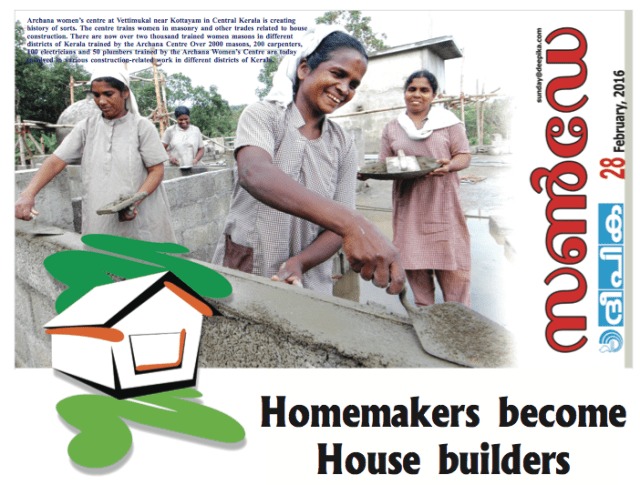
“Homemakers become House builders”

Homemakers becomeCheck out this article from Deepika, the Malayalam paper. It is a most excellent description of the work of Miss Thresiamma Mathew and the women of Archana Women’s Centre in Kerala where hundreds of women have been trained in masonry, carpentry and plumbing. Click on the link below to read the full article.

Feb 26 article in Deepika.

Posted in Uncategorized | 1 Comment

India: Research and Reflections

Please join me for on May 5 as I share my India adventures with you.

Susan Moir, Director of Research at the UMass Boston Labor Research Center, has recently returned from 3 months in India. Join us for Indian food and Susan’s report back on her Fulbright sponsored trip. Be the first to hear plans for next year’s planned “Building Bridges: The First Delegation of US Tradeswomen to India.

Thursday, May 5, 6-8 PM

At 1199SEIU, 150 Mt. Vernon St, Dorchester, 2nd floor

Please RSVP to tradeswomenbuildingbridges@gmail.com

Posted in Uncategorized | 1 Comment

Goodbye to India for now

At 3 am tonight I leave Mumbai and India. I will be home at 3 pm Thursday. I am very glad to see my family and friends and dog, to sleep in cool weather and get back to work that I love and a community that has supported and nurtured me through some miraculous transformations and opportunities.

And I will miss India. It has been the most fantastic and fun adventure. India is so complicated and challenging, so different from my home, so rich in its culture, politics and people, almost indescribable. Mumbai is noisy, full of trash and in a state of near anarchy. The city is often dubbed “vibrant.” What an understatement. Twelve and a half million people live in Mumbai. It has double the population density of New York City, but consider this. Mumbai’s population is horizontal. There are almost no skyscrapers and few high rises in most areas. Everyday Mumbai is like Times Square with 24-hour rush hour traffic. New York is Clark Kent to Mumbai’s Superman.

The people of India have been described as argumentative. To a non-India language speaker … well, there are 700 languages so the first question may be which am I hearing. An overheard conversation between friends or co-workers that sounds like conflict to an outsider could be just passionate opinions. Those of you who know me well can probably understand how very comfortable that can make me feel here. People are amazingly well informed. We have four daily English language newspapers delivered to our hostel every day. There are more daily papers in Hindi and local languages.

I was so lucky to almost accidentally find the Tata Institute of Social Sciences (TISS) and, with the assistance of the Fulbright staff, to be able to affiliate with the Centre for Labour Studies and the Advanced Centre for Women’s Studies. The campus is small and the curricula progressive and focused on social change. The school practices aggressive affirmative action and the student body and faculty reflect the great diversity of India, especially by caste and gender. On any day, at a meal, in an elevator or just walking across campus, I have had wonderful and informative conversations on social conditions, politics, global economics, migration, poverty and patriarchy. I have watched and played cricket, learned and got beat badly at a board game called karoom. I attended yoga and Hindi language classes. I have lived in a dorm– in a triple– with a great group of women less than half my age who have become my friends. We have had long conversations about India and our work here, what it is like for an outsider, what we love and what we find confusing and/or difficult. We have eaten many meals together in the dining hall, local restaurants and last night in a rooftop bar. I have been the dorm mom and they have taught me modern heterosexual dating rituals.

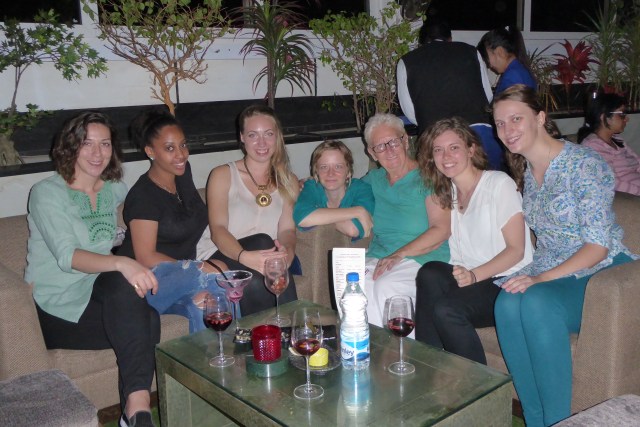
P1020050

Konstantina, Batseba, Mia, Hanna, me, Mirjam and Eva

Indians have a custom called adda. It essentially means taking the time to sit and just talk about serious and worldly issues. It does not mean setting up a meeting or even making a date to talk. It means stopping to talk now. Adda is one of the gifts from India that I want to take home.

Traveling around the country by myself with limited to no language skills was often difficult. I have been to nine cites while being very bad at India’s transport systems. I have missed trains and tried to board one when I thought I had a ticket but actually did not. I have paid outrageous cab fares on many occasions. I took an all night bus ride that was so noisy, bumpy and cold I hardly slept. When the driver yelled, “airport” I got off in a haze and then realized I was in the middle of nowhere at 4:30 in the morning and I really had to pee. I have been embarrassed at my screw ups but I console myself by remembering that my research has gone really well and I can’t be good at everything. And eventually I always go where I was going.

I am not romanticizing India. It is a very tough place. It is no vacation—except in the vacation oases where tourists and beggars share a symbiotic economy. To live among the people of India is to observe pervasive poverty and experience endless chaos. But I have also been witness to liveliness, an engagement with life that I do not see in the place I call home—the place that Indians call America no matter how many times I say I am from the United States. “America is a dream and a continent.” I explain. “The United States is the place that sells arms to both India and Pakistan.”

I am so lucky that I will be returning to India next January. The second part of my Fulbright fellowship will focus on building an international network by and for women working in the global construction industry. I will continue to post here on that and other subjects, sometimes not sequentially as I have a lot of material form this trip that I will be writing up over the next few months.

I thank you all for following my travels. I appreciate comments if you have time.

For those at home, see you soon. For those in India, see you in January 2017. For my “Swedish” girlfriends, stay in touch.

Calling my flight. Off I go.

Love and peace

susan

Posted in Uncategorized | 7 Comments

Equality for girl children

I had a fun and interesting couple of days in Pune hosted by Shraddha Borawake, photographer and new relation by marriage to my old friend, Nancy Falk. Shraddha did a project on women in construction some years ago and we are exploring future collaboration. My favorite of her short films is “Will You Wear the Pants?” This past Tuesday, we sat down with Shruti Purandare to find out more about the work of Tara Mobile Creches Pune. TMCP is one of the organizations in India that is providing child care for the children of construction workers– an area in which India is far ahead of the United States.

One of the most hopeful things I have heard since starting my research was from Shruti. Construction is a family business here and the workforce is very mobile. This makes it difficult for the children to continue their education. It is doubly difficult for girls who are expected to take on household responsibilities at a very young age. TMCP has a program for kids of construction workers to continue their education in residential schools and this year, for the first time, they have more girls entering the program than boys.

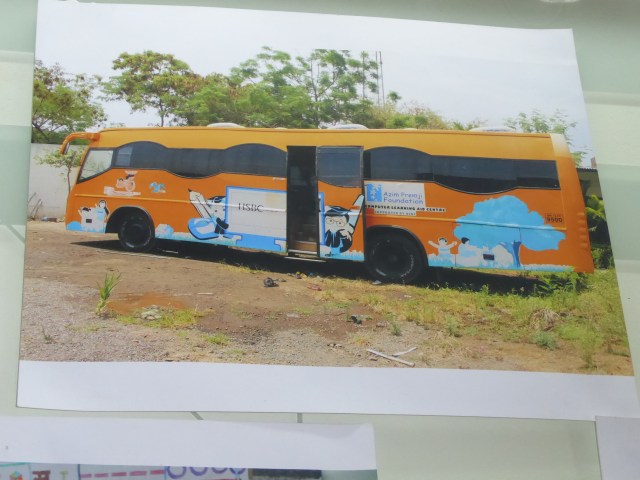
Another amazing thing that TMCP is doing is this mobile computer lab that is introducing kids in construction families to computer skills.

2016-03-22 13.04.05

I am WAY behind in my field notes online but you can see more details of our meeting with TMCP in the Field Notes tab on my home page.

Shraddha, Shruti and me at the Tara Mobile Creches Pune office.2016-03-22 13.00.56

Posted in Uncategorized | 1 Comment

To the Moirs: Walking in Uncle Fred’s Footsteps

To my cousins, children, nieces, nephews and all other Moirs,

You remember when Auntie Elsie died and I received five big boxes of her stuff and we held the Holy Yard Sale in my yard in Jamaica Plain and I made you take home rosaries and holy statues, a lifetime of possessions of a wonderful woman and terrific aunt who was in the convent for almost 50 years before she left and moved to Florida with her girlfriend?

I kept a couple of things.

One was a metal box of papers. When I finally opened that box a few years later, I found 36 letters, most of them from our great Uncle Frederick to our great grandparents in Cheshire outside of Liverpool, England. Fred was a sergeant in the British Army and he was stationed in Bangalore, India when he wrote the letters between 1911 and 1917.

Let me tell you a couple of things about Fred. He was a sketch artist and cartoonist. The letters include a couple of his drawings and references to sketches he had published in Indian newspapers. He was engaged to Mill in England, but broke off the engagement when he fell in love with Miss Marjorie Lee in Bangalore. Marjorie was Anglo-Indian, not the mixed race meaning of that term, but the other meaning. She was born in India and I don’t think she had ever been to England. Fred tried very hard for several years to get out of the infantry and into Supply and Transport. He was unsuccessful and in 1916, he was shipped out, first to Alexandria Egypt and then to Mesopotamia. The last three letters from Marjorie and her mother are to our great grandparents and to another Elsie, our great aunt Elsie Rawlinson. We learn that Fred and his best friend, Robinson, were killed within a couple of days of each other in Basra, Mesopotamia in February 1917.

I brought copies of the letters with me to India in hopes that I would get a chance to go to Bangalore and walk around where Fred might have been. I put the trip off because I did not really think I would find any traces. Bangalore is India’s most modern city. But then an opportunity happened and I went there Thursday afternoon.

I was very surprised when I reached the city center to find the infrastructure of the Raj (the British Empire in India) intact, beautiful and still in use. I came into the center on Infantry Road and thought, could Fred have lived here? The next thing I saw was the Post Office and I thought perhaps Fred mailed his letters from here. One of the letters is from Hugh Lee (Marjorie’s father?). It is during the war and he tells Fred that there is a position available for him in the Post Office, but he needs to hurry back because the job cannot be kept open for too long. A little down the road past the Post Office, today’s State Assembly and Courts meet in buildings Fred might have entered.


Behind the Courts is a beautiful park, Cubbon Park in Fred’s time, now named Sri Chamarajendra Park. Would Fred and Marjorie have walked through Cubbon Park? Maybe gone to concerts at the bandstand.

We know from the letters that Marjorie and her family lived on the Residency Road. It was very hot so I decided to take a tuktuk to Residency Road. Just as I got in we passed a Police Station that Fred would have walked past. A few minutes later, we rounded a corner and there was the Cantonment—the military area established by the British military. This is where Fred would have worked.  Since independence in 1947, these are the sites of the Indian Army. Speeding past the cantonment in the tuktuk, I spotted the office of the Supply Depot, the office where Fred sought to be transferred, the position that might have saved his life if he had received the transfer. Across the street was the parade ground where troops would have mustered.

I had the driver drop me off at the end of Residency Road. Big mistake. It was crammed with traffic and construction and there was nowhere to walk. Looking down the street, I could see that Residency Road was all new buildings. But then I saw an old one. Now a pretty shabby hotel, this would have been a shiny residence in the 1900s. Maybe Marjorie’s home? Further on there is a suspiciously crossless Catholic Church. It could have originally been the church that the British of Residency Road attended. It would have been High Anglican, the Protestant denomination that Fred’s brother, our grandfather Jack, left when he converted to marry Nana.

I needed to get out of the traffic and onto a sidewalk. I headed toward an intersecting street across a little park. And then I saw the monument—a monument to the British and Indian soldiers who died in World War I. And on the side that I was facing, it said “Mesopotamia,” the theater of war where Fred served and died, today’s Iraq. In English and Kannada, it honored not only the British and Indian officers, but also the NCOs (non-commissioned officers). Fred would have been an NCO.
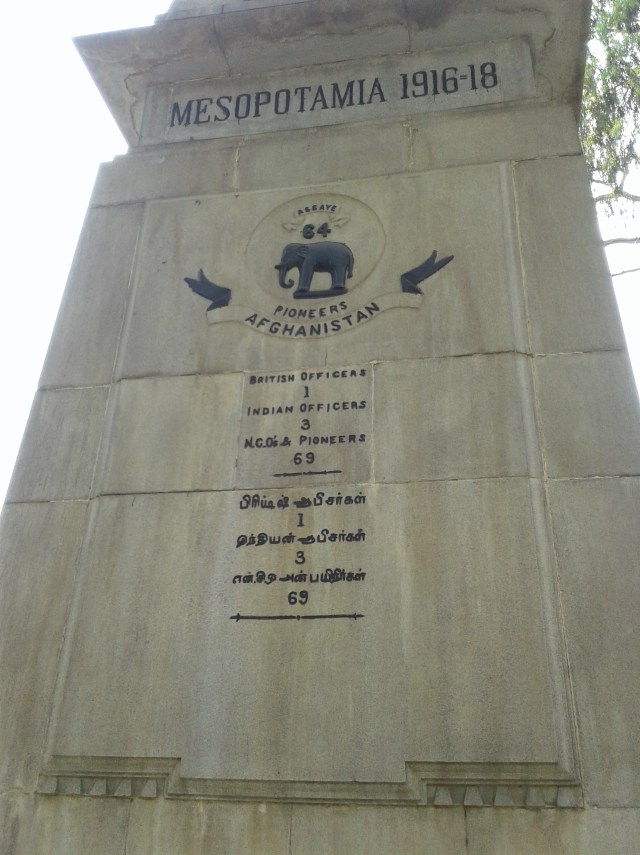
monument

I burst out crying and stood sobbing on the sidewalk. I told the street vendor standing beside me why I was crying. He was kind in a way that Indians are although he had no idea what I was saying. After a few minutes, I walked around to find the gate into the little park. A guard came to stop me, but when I showed him Fred’s letters and explained why I wanted to get closer, he opened the gate. He stood near me as I cried and took some pictures.

You know, my cousins, that I have spent my life fluctuating between peacenik and socialist. I am not proud that my relative was part of an occupying army. And I am not ashamed. It just is what a working class guy with no prospects might have done at the turn of the twentieth century—or the twentieth-first. And on the 100th anniversary of the Easter Rising, let us remember that Nana’s people in Ireland were living under the other end of British imperialism.

Like many before and since, our Great Uncle Fred was the fodder of war and paid the price. I am proud that we can remember him as a person and that his memory is recognized in the city where he found love, the city that was his home.

Posted in Uncategorized | 8 Comments

Two days in Kerala

I am traveling so much, learning so much and I am so tired. I have not had time/energy to organize pictures, words or thoughts. Tonight I am in the airport in Cochi, Kerala waiting for a late plane to Bangalore. Let me show you in pictures how my last few days have been.

A little over a year ago, I learned about the Archana Women’s Center in Ettumanoor, Kerala. They had a big Women’s Day Celebration featuring the training programs in masonry and carpentry that they have done for women. I hoped to visit the Centre while here but it did not look like it would happen until I met Renu Varughese at the Fulbright Conference in Jaipur a couple of weeks ago. Renu is from Kerala and when I told her about Archana, she offered to go there, see if it was real and ask if they would meet with me. She met Miss Thresiamma Mathew, Director of the Centre, and arranged for a driver, Mr. Binu John of Hebron Travel, to pick me up at the airport and take me to a nearby hotel. (Just for some geographical context, it is about 1000 miles form Bombay to Kerala, like traveling from Boston to Atlanta). On Tuesday, I took a tuktuk from the hotel to the Centre and had a wonderful day with Miss Mathew and the women of Archana.
Here are some pics and people I met.

Miss Mathew and the Archana Women’s Centre staff.

A focus group with masons Binababu, Ponnaamma and Ancyshaji. They are out of work for a number of reasons related to health and the depressed construction economy in Kerala.


The concrete block workshop at the Centre.

The woodworking workshop in another village.

Carpenter Omenah has studied interior design and has been making kitchen cabinets, wardrobes and doors for a nearby home.

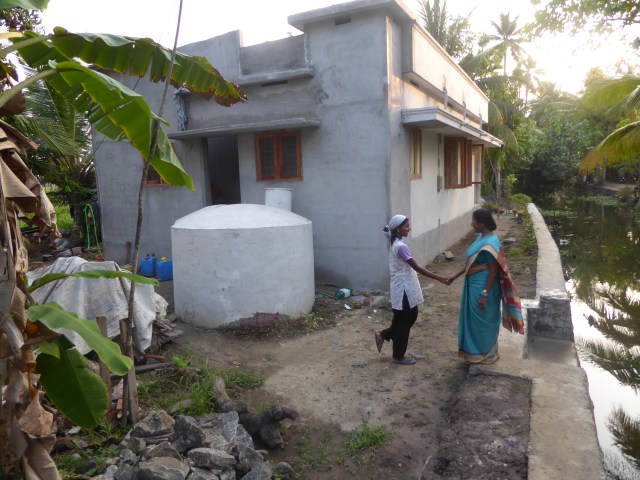
Off to the backwaters to see the Yaradhaka’s house that she, Valasala and Umadagal are building. We took long wooden canoes to Yaradhaka’s home where she lives with her husband and to children.

Umadgal was not there that day. Valasala went back with us and we went to the home she built and lives in with her family. 2016-03-16 17.43.10

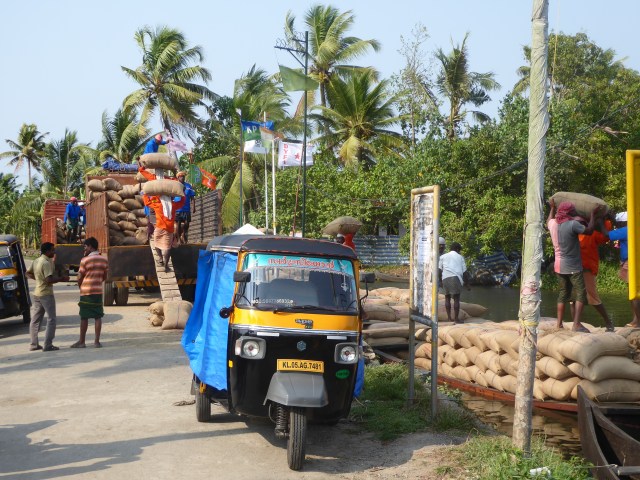
Some backwater scenes:

These men are loading paddy rice that has just been harvested. From boats to lorry.2016-03-16 15.58.56

This man is “herding” his ducks back to their home after they feasted on the paddy rice.

This woman is eating a coconut.2016-03-16 16.55.59

On Wednesday, Miss Mathew arranged for me to go to Thrissur- a 4 hour ride north with Binu- to see the Jeevapoorna Women’s Mason’s Charitable Society. This is a brick and tile workshop owned and run by women. They also run a canteen on the property which is the neighborhood’s favorite lunch place.

Annie Joseph and the mason’s of the Jeevapoorna Women’s Mason’s Society.

The women make concrete bricks and specialty tiles.

Binu was my driver and translator. If you know anyone traveling to Kerala, he can be reached through his website. Excellent service and we had a comfortable 8 hours riding around Kerala together in his van over two days.2016-03-17 14.25.59

Today I am in Bangalore with my great uncle Fred’s letters that he wrote to my great-grandparents between 1911 and 1917. He was stationed here in the British Army for a decade or more before World War I and killed in Mesopotamia/Iraq 99 years ago last month. I have an address from his fiancee and am going there to see what I can see. Nothing that Uncle Fred saw but at least the streets he walked on. To my cousins and children, I will post something on Facebook. My connections with my cousins a reason that I love Facebook.

To all my friends and family in the US, India and elsewhere, if you are still reading this and want to say hi in the comments, I would love to hear from you. I will be home three weeks from tomorrow. It has been an amazing, fascinating and enlightening trip. And I miss you all.

Love and peace.

Posted in Uncategorized | 13 Comments