Last International Tradeswomen Call of 2024 is Today- Join Us!

Looking forward to seeing those that can attend the Fourth Quarter International Tradeswomen call this month.

December 17, 2024 00:00 UTC time – Register for International Call

December 17, 2024 08:00 Manila time – Register for International Call

December 16, 2024 19:00 New York time – Register for International Call

After registering, you will receive a confirmation email containing information about joining the meeting.

This is our final meet-up of 2024 and we look forward to seeing many of you as we close out the year sharing the good work that we have accomplished!

Posted in Uncategorized | Leave a comment

TBB’s Fourth Quarter International Tradeswomen Call – Join Us!

Looking forward to seeing those that can attend the Fourth Quarter International Tradeswomen call this month.

December 17, 2024 00:00 UTC time – Register for International Call

December 17, 2024 08:00 Manila time – Register for International Call

December 16, 2024 19:00 New York time – Register for International Call

After registering, you will receive a confirmation email containing information about joining the meeting.

This is our final meet-up of 2024 and we look forward to seeing many of you as we close out the year sharing the good work that we have accomplished!

Screenshot
Posted in Uncategorized | Leave a comment

50% of the population is not getting the support it needs to get into the sector

Saint-Gobain, a major player in the European construction and industrial markets, shares their companies vision and struggles around supporting women in the construction industry.

Read Article Here

Posted in Uncategorized | Leave a comment

Delegate Reflections: Weathering the Storm: Building Resilience in the Tradeswoman Movement

By Noreen Buckley

On Sunday, November 17 th , a level 2 typhoon hit the Northern region of the Philippines. That day, our delegation was set to travel 3 hours to San Jose Del Monte, Bulacan for a community visit to meet up with our fellow union trade sisters in welding, plumbing, and painting. Sadly, our sister-to-sister outing was canceled due to the typhoon. This was the fourth typhoon that swept through the country in the previous ten days, the second that occurred while we were in the country. It is a change from the last half a century when typhoon season was from May to August.


Climate change and its effects on the construction industry are felt worldwide. Women are uniquely positioned to partner in steering the construction industry to embrace new strategies and ways of building that work for people as well as the environment. The construction industry is deeply involved in the clean-up and rebuilding of communities following natural disasters. We can also be involved in the building up of more resilient infrastructure to hold up against typhoons, hurricanes, tornados and wildfires.


Focusing on renewable energy sectors such as wind, geothermal, and solar energy, as well as electric vehicles, will continue to provide stable, union, building trades jobs while working toward building infrastructure that will hold up against the changing environment.


Women, seasoned and new to the trade, are not as confined by the established social norms in the construction industry. We are often the only woman on site thus seen as an outsider. This dynamic allows us to challenge and question conventions, opening discussions about how things can be done with different priorities in mind. Our tradeswomen meetups are significant in developing the heart of the tradeswomen movement via peer-to-peer support networks of women working with their tools. No one knows better the joys and struggles of lacing up those boots and walking onto a site every day.


The typhoon unfortunately denied us the opportunity to share a potluck meal and connect over stories of training, safety on construction sites, and the ups and downs of being a woman in the trades with our Filipina counterparts. The more we, as tradeswomen, hear each other, see each other, and validate each other, the stronger we will all be as we take our place next to our brothers as equals in building the future.

Posted in Uncategorized | Tagged , , , , | Leave a comment

Delegate Reflections: Mothers, Makers, and Builders: Stories from the Philippines Delegation

by Tonia Rivers

When I signed on to attend the Tradeswomen Building Bridges 2024 Philippines Delegation I really didn’t know that to expect. Sure I was privy to the hourly details of the delegation but the reality is I had no idea what was I walking into. I didn’t know anyone involved on a personal level, I was leaving for my family for nine days  and traveling to another county for the first time alone. I became wary but something in my heart told me to press on. I needed to be here.

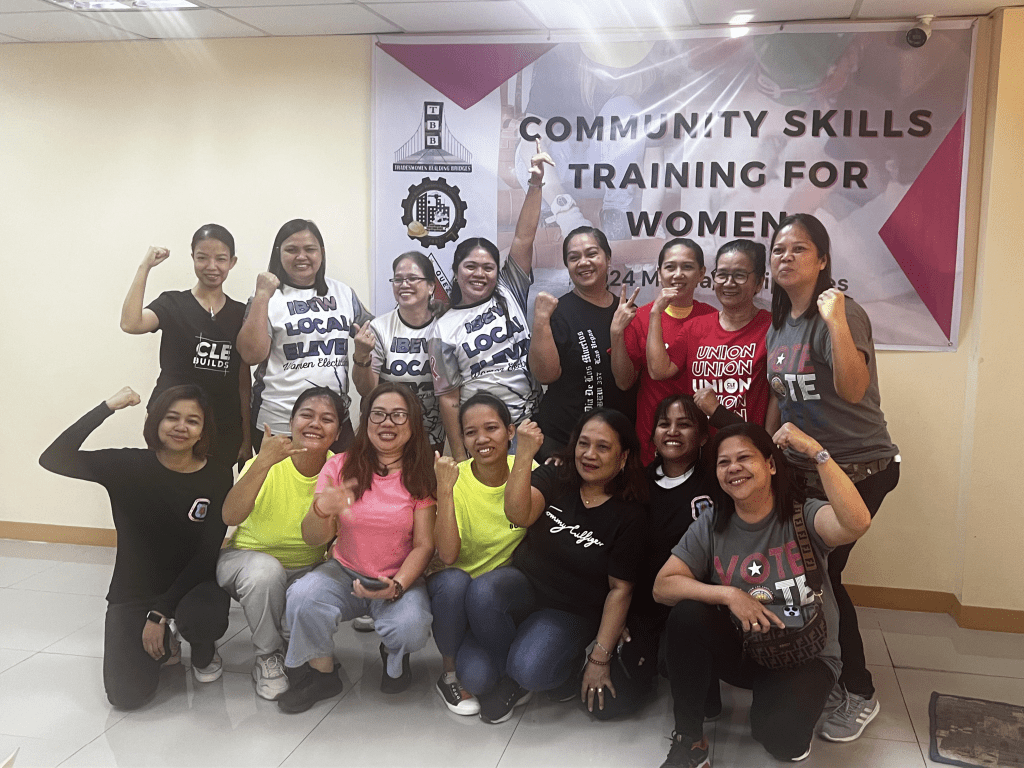
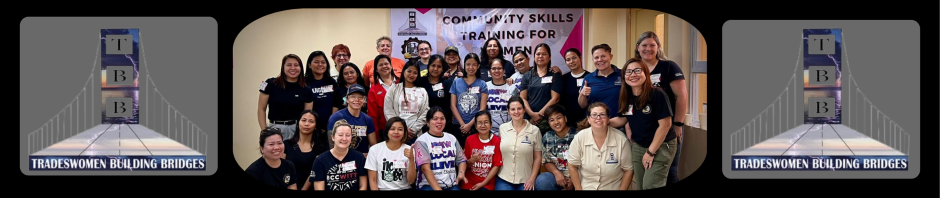
Just a few hours after arriving to the Philippines ,  I walked into a room full of dedicated women of all different ages who were full of life. Though they hailed from various regions across the country, they  gathered for a shared purpose: to expand their knowledge and skills to enhance their lives . You might have assumed they were longtime friends, but the reality is that most of them had just met during the training. They supported one another and often jumped in to help each other complete tasks. Their sisterhood was refreshing and contagious. These amazing women were united in heart by an industry we’ve all grown to love.

Some of the participants have careers in the construction industry. Others work in separate industries or are stay at home moms who wanted to gain a new experience . Like me, they took a leap of faith and stepped into the unknown with the hope of enhancing their lives. Eager to learn more about these incredible women, I engaged in conversations with each of them and found that many were mothers. We talked about the challenges of managing careers while raising children, touching on issues that resonated deeply. Many shared the difficulty of affording childcare, often relying on family support if it is available. Others opened up about the struggle to find a balance between their professional and family lives. The need to be present and available for their children often conflict with their careers. For some, the sacrifices felt too great, leading them to postpone their career aspirations to prioritize their children until they are older. They believe that their children’s success will ultimately reflect their own. Others expressed how, as mothers, they are often perceived as liabilities by employers , with the assumption that family responsibilities will take precedence over their job commitments. “Last hired , first fired” is an unfortunate reality for many women in the Philippines . 

Though the locations may vary, the challenges faced by mothers around the world are strikingly similar. As a mother of three myself, I understand the weight of juggling multiple burdens. Mothers are expected to be everything to everyone, leaving little for ourselves. I stand in solidarity with these women, knowing firsthand the struggles they face. I also recognize that the sacrifices they made this week to improve their skills will have a lasting impact, not only in empowering themselves but also in lifting up others. I will forever be deeply moved by their courage, inspired by their sacrifices, and empowered by their resilience. 
Posted in Uncategorized | Tagged , , , , | Leave a comment

Delegate Reflections: Kristine Byers and Doreen Cannon Chat about TBB’s Hands-On Training In the Philippines

Reflections By Kristine Byers and Doreen Cannon

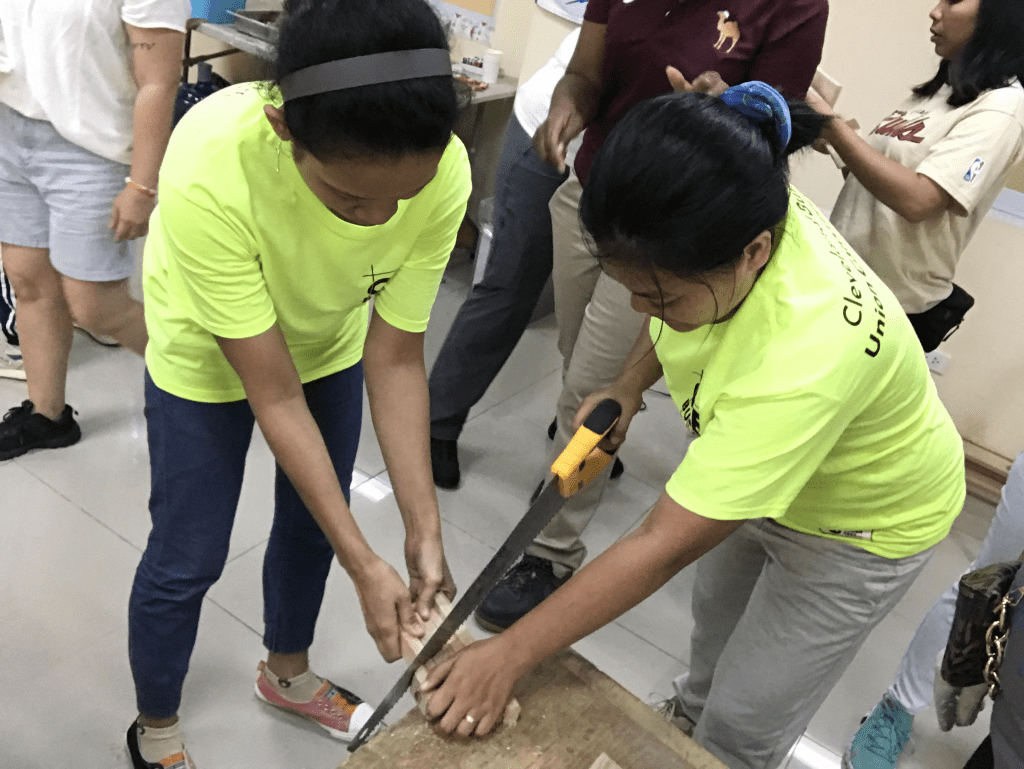
This year, Tradeswomen Building Bridges (TBB) embarked on a transformational journey to the Philippines, hosting hands-on skills training workshops in plumbing and carpentry. These sessions were designed to provide practical skills to Filipina women while fostering cross-cultural exchange and empowerment. For Kristine Byers, a Business Representative with the Carpenters’ Regional Council (CRC) in Edmonton, Canada, and Doreen Cannon of Plumbers Local 55 in Cleveland, USA, the experience was both challenging and deeply rewarding. As instructors and curriculum planners, they poured their time energy and attention into this project for months. Their reflections highlight the transformative power of collaboration, adaptability, and shared learning.

Adapting to Challenges


Kristine joined the delegation with enthusiasm, eager to bring hands-on carpentry training to life. However, the reality of acquiring tools and materials in a different setting proved more difficult than she anticipated. “When the right nails or screws weren’t available, we pivoted and modified the project,” she explained. This adaptability quickly became a cornerstone of the training, pushing Kristine to find creative solutions and rethink standard methods.

Similarly, Doreen faced hurdles planning the plumbing workshop. “Plumbing is very involved, and it’s difficult to come up with hands-on projects,” she reflected. But her team was determined to teach practical, everyday skills the participants could use in their homes. From mounting faucets to troubleshooting toilets, every project was designed to be accessible and empowering.

Empowering Through Skill-Building


The enthusiasm of the Filipina participants left a lasting impression on both instructors. Kristine noted their eagerness to learn and how they quickly mastered new techniques, often stepping up to assist their peers. “Their motivation, engagement, and teamwork were truly inspiring,” she shared. Despite many meeting for the first time, they worked together seamlessly, creating a sense of unity and purpose.

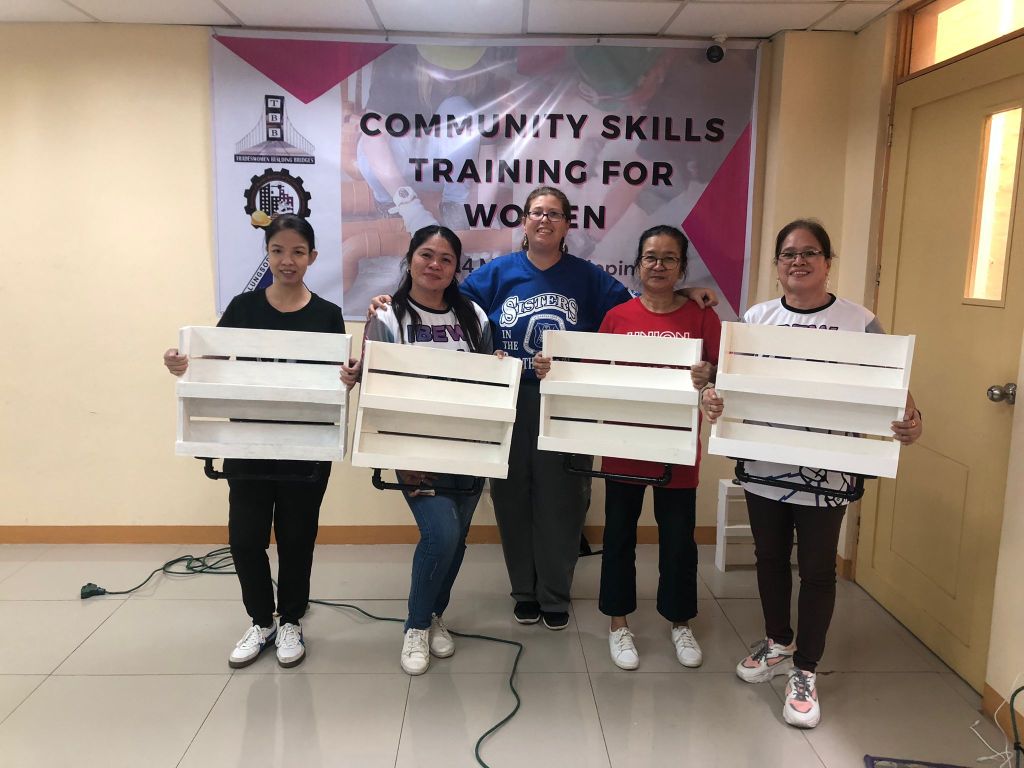
Doreen echoed these sentiments, describing their commitment as “contagious.” The participants took pride in every project, including a collaborative effort to craft a towel bar from steel pipe as part of the carpentry workshop. “These are issues they can now handle themselves when they arise in their homes,” she added, highlighting the real-life impact of the training.

A Transformative Experience for All


Both Kristine and Doreen were deeply moved by the emotional reflections shared during the wrap-up discussion. For many participants, the training was more than just skill-building—it was a path to empowerment. “They felt that the skills they learned could help them fix things at home, create products to sell, or even pursue a trade,” Kristine shared. From young women just starting out to senior participants eager to learn, each story underscored the importance of initiatives like TBB.

The experience also left a mark on the instructors themselves. Kristine found inspiration in the resilience and determination of the participants, as well as her fellow TBB delegates. “Their willingness to learn and contribute highlighted the power of collaboration and shared purpose,” she said. For Doreen, the opportunity to immerse herself in Philippine culture and history added a rich layer of meaning to the delegation. “This has been one of the best experiences of my life,” she reflected.

Looking Ahead


As Kristine and Doreen return home, they carry with them a renewed commitment to fostering opportunities for women in trades. “The momentum we’ve built here needs to continue,” Kristine emphasized. Both hope their reflections will inspire more tradeswomen to join future TBB delegations and experience firsthand the transformative power of building bridges across borders.

The TBB delegation’s efforts in the Philippines remind us all of the strength that comes from adaptability, collaboration, and shared purpose. In a world where opportunities for women in trades remain scarce in many places, initiatives like these pave the way for lasting change—one skill, one connection, and one empowered woman at a time.

Posted in Uncategorized | Tagged , , , , , , , | Leave a comment

Global Perspectives on Organizing: Lessons from the Philippines

On Tuesday and Wednesday, our organizing training continued with a wide variety of esteemed presenters. Representing the Akbayan Citizens Action Party, we heard from General Secretary Odan Gutierrez. He gave us an overview of the political situation in the Philippines and the electoral organizing that his party does. He was followed by Khylla Meneses, the Akbayan Youth General Secretary. She taught us about young people in governance. The youth village council is a unique way to include youth in politics and support their advocacy.

Ninian Sumadia presented on sectoral organizing in the context of the National Anti-Poverty Commission and her role as youth sector representative. NAPC is under the office of the president and part of the government structure. It functions to coordinate poverty reduction programs by national and local governments. The heads of 13 different federal agencies are members as well as four presidents of local government leagues. There are spots on the commission for 14 basic sectors like artisanal fisherfolk, NGOs, people with disabilities, senior citizens and youth. Ninian was appointed by a former president for a 3 yr term and the next president made an extension. Basic sectors have at least 100 organizations that are part of a sectoral assembly and then they hold elections for representatives. NAPC provides a mechanism to effect change and advocate within the government structure and it has been a great start for poverty reduction and alleviation. It provides a platform for policy advocacy, political participation, mobilization, education, capacity building, initiating partnerships, projects and initiatives and media presence. 

Josephine Parilla spoke to us on behalf of HOMENET international.  She was their first international president. They  organize women in informal employment and have members in 71 affiliates across countries. Informal employment is rising in the Philippines. These workers often face invisibility in statistics and lack of representation, lack of access to social services and lack of workplace protections. HOMENET has a role in organizing around health and safety in workplace, discrimination and harassment and unsafe conditions.

Our last guest was Abraham Reyes, a Project Coordinator for TGSL IndustriALL Solidarity Center Project. He reminded us about the importance of organizing and guided us on best practices for bringing new union members into our movement. He also gave us an overview of the organizing landscape in the Philippines.

The information provided by our guests  is particularly useful for us as North American union leaders in the construction industry because it provides valuable insights into innovative organizing strategies and structures that can be adapted to their own contexts. For instance, the involvement of youth in governance through mechanisms like the youth village council demonstrates how to engage younger generations in leadership and advocacy, ensuring the sustainability of union movements. The example of the National Anti-Poverty Commission showcases a model for structured representation and collaboration between basic sectors and government, which could inspire similar initiatives to strengthen labor voices in policymaking. HOMENET International’s approach to organizing informal workers highlights the importance of addressing the needs of underrepresented groups, such as subcontracted or precarious workers in construction, while emphasizing health, safety, and equity. Finally, Abraham Reyes’ emphasis on organizing best practices offers actionable strategies for growing membership and building solidarity, which are critical for sustaining and expanding union power in any industry. We are extremely grateful to all of those who took time out of their day to contribute to our delegation. Tradeswomen Building Bridges values information exchange and solidarity building between countries.

Posted in Uncategorized | Tagged , , , , | 1 Comment

Delegate Reflections: TBB TRAINING MY MOST MEMORABLE EXPERIENCE

By Juvy Carmenotes

Hello, my name is Ms. Juvy Carmenotes, I am an Arc welder in the Philippines. I love doing DIY stuff at home. Not only welding, but also some basic work like carpentry, electrical, plumbing and painting. Sometimes even masonry. I really do love man’s work; I felt like it’s my passion and what I want to do in my life. But I’m not good enough to do those kinds of works so I need more training. 

One day my Partner Dave and I are planning to have our own Training Center for my fellow women. I would like to empower them and give them some hope that we are not just women! We are women! Everyone deserves to have a better life, not only for ourselves but also for our family. I would love to share my thoughts and knowledge with them. Especially those who are being abused.

We already made some plans for our future training center but the BIG question was how can I make it possible? Who, Where and Why?  So, then that’s how Tradeswomen Building Bridges came to my life. My partner did some research about women’s construction in the Philippines, and he found TBBs site. It was perfect timing that they were coming to visit the Philippines in order to empower women and share their unique skills.  I messaged the TBB facebook page and got an answer from them. They connected me to AWWCI who organized the event to make it happen. 

First, I would like to thank the AWWCI organization for letting me join the 5 days training with TBB delegates. I live 4 hours away from Manila and they even gave me a free accommodation. Thanks to Ms. Jane Vargas and Ms. Mheanne  Vargas. Thank you so much for your advocacy and for letting us know about women’s rights.

Big thanks to those TBB trainer Ms. Kristine Byers for teaching us, how to build our own shelves with a towel rack. Now I fully understand how to do proper measuring, which is my number one concern, because I am really not good at it. With a wrong measurement everything else goes wrong. I learned proper wood cutting using a saw and some electric tools with safety precautions. She made sure everyone was wearing their PPE, and made sure that everyone fully understood the importance of work ethic. Thank you for sharing some techniques to make our job easier and faster with good quality.  Now I am more confident to continue my pending carpentry work at home.

Big thanks as well to our plumber instructor Ms. Doreen Cannon, your passion in training also amazed me, its like Wow! I can’t even imagine that a woman plumber really exists, because I am only familiar with a woman welder, electricians etc. haven’t met someone like you. I am so glad to be your student. It is really a big shot for me to be trained by an international trainer. Sometimes I felt overwhelmed as everyone noticed lol! Thank you so much for sharing your knowledge with us. I’ve learned a lot from you in a very short period of time. I have learned how to join the pipes together and make sure they are even so the water can run properly.  I have learned that some water pipes must be elevated properly with a proper measure of heights. Thanks for sharing the techniques on how to level those pipes together. It is really a big help for me and for the other students. Now I understand why the pipes clog and I understand how the toilet flush functions. I can fix it in case there is a minor problem.  Basic knowledge in plumbing is a big help for me. It will help me to save my pennies. I don’t need to spend on a plumber for the basic problems. I wish we could do more training in the future so we can learn more about plumbing. Honestly, for me it is a more complicated job and I need more time to learn more.

Thank you both for your long patience and putting your heart in it. Your hard work is much appreciated. 

Of course, big thanks to the rest of the delegates, Noreen Buckley, Angel Anderson, Lori Griffith, Myra Hildreth, Amanda Kay Johnson, Cassandra Klewicki, Casey Aelbers, Diana Limon, Rachel Cloutier and Ms. Tanya. Without you guys our training would be more complicated. Thank you so much for your guidance and assistance. You worked with every one of us to make our projects possible and made sure it was a quality output. Assisting us one by one is not easy but you put your heart and effort into it and made sure we all could understand what we were doing. Every one of you has a different spice lol!  All of you were so very kind and good human beings Thank you all for the laughter and tears that we shared in a week. 

I feel like we’ve known each other for a very long time, especially my fellow students. I am so grateful to know you all. I did not know anyone when I joined the training but it was very easy for all of us to become a family. Laughter’s and bonding together is priceless. Spending and enjoying time together was great, it took away all our worries in life. Helping each other whilst on the training is a great example of a strong woman power! You are not just friends for me but also my new family. I felt at home and I never felt homesick because everyone was so kind and a true person. Our happy memories will remain forever, and I am looking forward to more and seeing  you again in the near future. I would love to be part of your mission again. 

Again, thank you all for the successful training and for sharing your specialty with us!

Love you all and see you all again next year. Have a safe journey back home!! 

Posted in Uncategorized | Tagged , , , , , , , | Leave a comment

Delegate Reflections: Supporting Filipino Tradeswomen in the Fight for Equality in Construction

By Angel Anderson

As week one of the Tradeswomen Building Bridges delegation draws to a close, I am reflecting on how grateful I am. I have had the opportunity to work with my delegate colleagues, allied organizations, and the Filipino sisters. I’ve learned so much about the barriers Filipino women face when attempting to enter and maintain employment and training opportunities in the construction workforce.

I learned that the average construction worker wage in the Philippines is no higher than that of an average worker in an unskilled work role. From what I understand, it’s significantly lower than that of a worker in a call center.

Construction is one of the most booming industries in the Philippines right now. There is space for new workers to enter, but women still hold less than 2% of that space.

From my understanding (after speaking with participants and event organizers from AWWCI) this may be partially to do with fear of not being accepted and/or taken seriously by (primarily) male employers, companies, and counterparts who are responsible for assuring the employment and safety of women in these work spaces.

For myself, being a unionized female worker in Canada I already know that I will never have to face this type of discrimination alone. Our unions have the strength and power to act on our behalf. The union fights for our rights whenever we face the same adversities that Filipino women face. The Filipina women stand together, but they have much less institutional support. We all know what it’s like to work in a culture that does not accept us working in traditionally male dominated fields.

This week I had the privilege to witness the level of dedication, commitment, and courage that all of the women who participated in our carpentry and plumbing training demonstrated. Many of them took time off of work, left their families, and traveled great distances for the opportunity to grow and learn with us. They knew that this would be a very limited, and maybe “once in a lifetime” training opportunity for them.

I think as a Canadian woman I take for granted that I have these training opportunities available to me regularly. I have secure employment as a female worker, and also protection against discrimination from my union, employers, and colleagues at all times.

The women out here have much less, if any of that. To create lasting changes that will help them to move forward in construction, it’s my belief that the AWWCI cannot do it alone. In my opinion we need to see more North American organizations, employers, and companies take a stand and use their power and influence in the industry to advocate for women’s rights here. We need to support more programs for women in the Philippines.

In Canada our rights have already been established, and it is my hope that any organizer, employer, and worker who reads this takes the time to consider what we have available to us currently, and what we have to offer. We need to help these hard working tradeswomen find the strength to break through the barriers that they face, and get to where they deserve to be.

My biggest take away from this delegation so far has been that tradeswomen in the Philippines are not fighting for anything less than to have equal rights and to be accepted in an industry that they are passionate about. They are painters, carpenters, electricians, etc, and all they want is the right to offer skilled work, and to provide much needed services in their communities. In my opinion they deserve that right and with more support from powerful North American construction organizations I believe that this is possible.

Posted in Uncategorized | Tagged , , , , | Leave a comment

Building Global Solidarity: Lessons from Day 1 of Organizing Training in the Philippines

This week, our delegates are receiving organizing training put on by AWWCI and their partners. Our first day was full of valuable information and networking. We started off with welcome addresses from Jane and Meann Vargas of AWWCI. Delegate Diana Limon from IBEW Local 11 spoke on behalf of our organization about the importance of organizing.

Then we heard from Attny. Ernesto Arellano, the current president of the National Union of Building and Construction Workers, a Philippine affiliate of BWI and the first labor organization in the country that was registered under the category of an industry union. He gave us an overview of the labor force in his country. In the Philippines, about 10%-12% of the entire labor force is organized into unions. Construction makes up about 12% of the labor force. He went over the large unions in the Philippines and the collective bargaining laws that dictate organizing on a national level. 

Next Cathy Gayo spoke to us about effective leadership strategies. Cathy is the Education and Information Officer at Associated Labor Unions (ALU-TUCP). She also serves as a project coordinator at the Support Service Institute for Women. The delegates enjoyed the interactive workshop meant to develop team-building and leadership qualities.

We heard a presentation from Joseph Aquino, a community facilitator and President of SARANAY Community-based association. He also holds the position of Sectoral Council Member at the National Anti-Poverty Commission. He taught us about the importance of identifying common issues and concerns of workers, the need to document workforce stresses and hazards, and organizing with a focus on women. We also discussed minimum wage vs. living wage, something we also discuss regularly in North America. The minimum wage in the Manila metro area is about 610 pesos per day. Higher than other parts of the country, but still only about $10.40 USD at the time of writing.

The day ended with a presentation from Joel Odio from the Circle of Advocates for Workers. He taught us about the International Labor Organization and its role within the United Nations. We went over the tripartite structure, ILO objectives, principles and it’s core fundamental conventions. Delegates left the presentation with a much deeper understanding of their rights under international labor law.

This day of training is especially important for our North American delegates as they prepare to return to the United States with fresh perspectives and actionable insights. By learning from the experiences and strategies of labor organizers in the Philippines, our delegates are gaining a broader understanding of global labor challenges and innovative approaches to address them. The discussions on collective bargaining, leadership development, workforce hazards, and the role of international labor law equip them with tools to strengthen organizing efforts back home. These lessons will not only enhance their ability to advocate for workers’ rights but also foster solidarity across borders, reinforcing the universal struggle for fair wages, safe working conditions, and equitable treatment.

Posted in Uncategorized | Tagged , , , , , , , | 1 Comment